

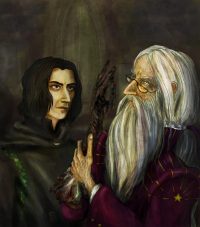
Harry’s Unanswered Question
“Professor, what happened to your—?”
“I have no time to explain now,” said Dumbledore. “It is a thrilling tale, I wish to do it justice.”
(HBP4)
At least four times in Half-Blood Prince, Harry asks Dumbledore to explain what happened to his right hand. Each time, Dumbledore smiles and implies that it is not the right time to tell the story, but that Harry will hear it some day.
Of course, Harry’s overwhelming sorrow and anger at Dumbledore’s subsequent death leads Harry to abandon the thought of ever actually having the chance to hear that “thrilling tale.”
Though Harry eventually does reach his own conclusion that Dumbledore’s hand injury was directly related to Marvolo’s ring Horcrux and its destruction, Dumbledore never actually confirms or denies this story, allowing Harry to give life to his own theory and to believe it with little question.
But for the rest of us, the readers who were present before Harry even enters the book in Chapter Three, it doesn’t take a trip into the Pensieve to piece together an alternate theory on what may have actually happened to Dumbledore’s arm.
From Tongue of Flame to Hand of Char
In chapter two, “Spinner’s End,” Snape surprises Bellatrix by agreeing to make the Unbreakable Vow with Narcissa (HBP2). With Bellatrix as witness, along with the obviously spying Wormtail just out of view, we watch as they clasp their right hands together and see flames shoot from a wand binding their hands and their words in a most vivid and unusual manner.
Bellatrix’s astounded face glowed red in the blaze of a third tongue of flame, which shot from the wand, twisted with the others, and bound itself thickly around their clasped hands, like a rope, like a fiery snake.
(HBP2)
The chapter ends on that rather ominous note, setting us up for Draco and Snape’s later actions. But positioned as it is in within the book, could it actually be setting us up for a more immediate scene?
When we finally catch up with Harry for the first time, it occurs in the very next chapter. He is at Privet Drive, awaiting the arrival of Professor Dumbledore. And what is the first thing Harry observes about Dumbledore’s appearance? “As he replaced his wand in his pocket, Harry saw that his hand was blackened and shriveled; it looked as though his flesh had been burned away.” (HBP3)
It seems unlikely a coincidence that we are given a clear view of a right hand engulfed in flames, only to discover just 11 pages later—while the image of the Vow is still fresh in our minds—a right hand that has been badly charred. Is it not entirely likely that the right hand described as engulfed in flames in HBP3 is the very same right hand now described as burned later in the same chapter?
The evidence is very strong that it was not Snape who made the Unbreakable Vow, but Dumbledore. It was not Snape’s hand engulfed in flames, but Dumbledore’s! This seems the only visibly obvious explanation for Dumbledore’s blackened hand.
Misleading The Witness
J.K. Rowling brilliantly leaves certain plot lines open in every book so that Harry may incorrectly connect them, though ultimately never to his detriment! We have witnessed this time and time again; think back to the various lines of reason that led him to his incorrect assumptions about Snape in Philosopher’s Stone, about himself in Chamber of Secrets, about Sirius Black in Prisoner of Azkaban, and well, the list goes on and on . . .
In Half-Blood Prince, Harry begins to piece together the idea that the ring and the hand injury must be connected (at least in their timing) upon return from their first trip into the Pensieve.
He turned away again, and was almost at the door when he saw it. Sitting on a one of the little spindle-legged tables that supported so many frail-looking silver instruments, was an ugly gold ring set with a large, cracked, black stone.
“Sir,” said Harry, staring at it. “That ring—”
“Yes?” said Dumbledore.
“You were wearing it when we visited Professor Slughorn that night.”
“So I was,” Dumbledore agreed.
“But isn’t it . . . sir, isn’t it the same ring Marvolo Gaunt showed Ogden?”
Dumbledore bowed his head. “The very same.”
“But how come—? Have you always had it?”
“No, I acquired it very recently,” said Dumbledore. “A few days before I came to fetch you from your aunt and uncle’s, in fact.”
“That would be around the time you injured your hand, then, sir?”
“Around that time, yes, Harry.”
Harry hesitated. Dumbledore was smiling.
“Sir, how exactly—?
“Too late, Harry! You shall hear the story another time. Good night.”
“Good night, sir.”
(HBP10)
“Well, maybe you ought to think about retirement yourself,” said Slughorn bluntly. His pale gooseberry eyes has found Dumbledore’s injured hand. “Reactions not what they were, I see.”
“You’re quite right,” said Dumbledore serenely, shaking back his sleeve to reveal the tips of those burned and blackened fingers; the sight of them made the back of Harry’s neck prickle unpleasantly. “I am undoubtedly slower than I was. But on the other hand . . .”
He shrugged and spread his hands wide, as thought to say that age had its compensations, and Harry noticed a ring on his uninjured hand that he hand never seen Dumbledore wear before: it was large, rather clumsily made of what looked like gold, and it was set with a heavy black stone that had cracked down the middle.
(HBP4)
So the ring that now seems to be set aside on a special table, not to be touched—much as a museum piece or perhaps a dangerous work-in-progress in a scientist’s lab—was clearly seen comfortably and safely worn on Dumbledore’s uninjured hand some time earlier.
However, three chapters later, after they return from yet another trip into the Pensieve, Harry takes note of the ring’s absence.
Harry got to his feet. As he walked across the room, his eyes fell upon the little table on which Marvolo Gaunt’s ring had rested last time, but the ring was no longer there.”
“Yes, Harry?” said Dumbledore, for Harry had come to a halt.
“The ring’s gone,” said Harry, looking around…
Dumbledore beamed at him, peering over the top of his half-moon spectacles.
“Very astute, Harry, but the mouth organ was only ever a mouth organ.”
And on that enigmatic note he waved to Harry, who understood himself to be dismissed.
(HBP13)
Nitwit! Blubber! Oddment! Tweek!
Considering the fact that the ring was in plain sight up until Chapter Ten, but after that time is never seen again, it is most plausible that the destruction of the Horcrux took place sometime between the ring being set on the spindle-legged table and its noted absence. Unsurprisingly, this is not Harry’s assumption.
Harry is used to the enigmatic words of Albus Dumbledore, and seems to accept the authority of their assumed meanings and connections with very little question. Back in his first year, there was never any explanation of how the Sorcerer’s Stone was destroyed and Harry never even requested one. (PS17)
If the ring’s absence is indicative of the Horcrux’s destruction, then we clearly did witness the blackened hand before seeing (or rather, noting the absence of) the ring in its destroyed state. Therefore, the destruction of the ring/Horcrux, the crack in the stone, and the burning of Dumbledore’s hand are not concurrent, but three separate matters of erroneous coincidence: a red herring for Harry and the reader, supported largely by the loose inferences of a very secretive and always enigmatic Dumbledore.
Considerably later in the book, in the chapter entitled “Horcruxes”, Dumbledore enables Harry’s already imagined story to take on just a bit more form. Again, Dumbledore never actually explains in any clear or convincing manner the actual story behind his tragically injured hand.
“You are forgetting . . . you have already destroyed one of them. And I have destroyed another.”
“You have?” said Harry eagerly.
“Yes indeed,” said Dumbledore, and he raised his blackedned, burned-looking hand. “The ring, Harry. Marvolo’s ring. And a terrible curse there was upon it too. Had it not been—forgive me the lack of seemly modesty—for my own prodigious skill, and for Professor Snape’s timely action when I returned to Hogwarts, desperately injured, I might not have lived to tell the tale. However, a withered hand does not seem an unreasonable exchange for a seventh of Voldemort’s soul. The ring is no longer a Horcrux.”
(HBP23)
Truly, not much of an explanation there! There can be little doubt that those last two sentences represent sacred truths to Dumbledore. However, the connection between them is tenuous at best. Given the very disjointed and rushed tale that preceded those two statements, it is clear that Dumbledore is holding back from actually saying very much. Remember, this is a wizard who is not afraid to say “Voldemort.” He could not possibly be afraid to talk in his usual flowing English about such an important part of his story as how to destroy a Horcrux! But then again, to Dumbledore, the omission of a few facts would not seem an unreasonable exchange for the ultimate destruction of Voldemort.
In fact, there can only be an assumed connection between any of the sentences spoken in that rather inscrutable paragraph in HBP23. In strong canon contrast, look at how well Dumbledore’s sentences connect and flow to teach and inform Harry in the preceding paragraph on the very same page.
“But firstly, no, Harry, not seven Horcruxes: six. The seventh part of his soul, however maimed, resides inside his regenerated body. That was the part of him that lived a spectral existence for so many years during his exile; without that, he has no self at all. That seventh piece of soul will be the last that anybody wishing to kill Voldemort must attack—the piece that lives in his body.”
(HBP23)
The Story That Fell Through The Crack
Cursed jewelry items being all-too familiar to Harry of late (as in Chapter 12, Silver and Opals) it is a bit less surprising that Harry doesn’t further question matters of the ring. What’s more, with newly learned information about Horcruxes to completely dizzy the mind, how could Harry possibly be drawn to thinking back to the day when Dumbledore first rescued him from Privet Drive and took him to meet Slughorn? If he had, he might have recalled an incongruously relaxed Dumbledore, already injured and calmly displaying the so-called cursed ring on a rather obviously uninjured left hand. Harry is, no doubt, left to assume that the crack in the stone relates directly to the destruction of the Horcrux.
Interestingly though, there is no evidence within the canon to support any notion that the crack in the stone is what destroyed the Horcrux/ring at all. All we know is that a whole generation prior to Tom Riddle making it into a Horcrux, back when his grandfather Marvolo Gaunt first showed the ring to Bob Ogden, there was no crack in it. Instead it is described as “the ugly, black-stoned ring he was wearing on his middle finger . . . with the Peverell coat of arms engraved on the stone.” (HBP10)
Working under the theory that Dumbledore destroyed the Horcrux in his office sometime after Harry saw it on the spindle-legged table, the question of how the stone in the ring became cracked may truly be a far more intriguing and relevant problem.
Perhaps the answer to that lies in the affects of creating a Horcrux. Who knows what manner of scar is left by such an act of evil?
By demonstrating a deep trust in Harry and a faith in his abilities throughout Half-Blood Prince, Dumbledore encourages Harry to build on and believe in his own assumptions, thus employing the perfect strategy for not ever having to tell his actual tale.
Pass on the Polyjuice
So just how did Dumbledore pass for Snape? Surely, this act of disguise would not involve the highly overused and extremely fallible Polyjuice Potion. I assert that a wizard of Dumbledore’s abilities—“Order of Merlin, First Class, Grand Sorc., Chf. Warlock, Supreme Mugwump, International Confed. of Wizards” (PS4)—would not rely on a potion for such a sensitive and high-priority mission. He need only trust in his own lofty and dedicated abilities, having fully mastered such sophisticated wizardry as human transfiguration, a study of magic we not-so-coincidentally see for the first time in this very book. It is a magic so advanced, the sixth-year students just barely begin to scratch its surface.
They had just embarked upon the immensely difficult topic of human transfiguration; working in front of mirrors, they were supposed to be changing he color of their own eyebrows.
(HBP15)
“Well, you can’t break an Unbreakable Vow . . . ”
So what do we know about Unbreakable Vows? Ron tells Harry what little he knows of them.
“Well, you can’t break an Unbreakable Vow . . . ”
“I’d worked that much out for myself, funnily enough. What happens if you break it, then?”
“You die.” Said Ron simply. “Fred and George tried to get me to make one when I was about five. I nearly did too, I was holding hands with Fred and everything when Dad found us. He went mental,” said Ron with a reminiscent gleam in his eyes.
(HBP16)
Based on Mr. and Mrs. Weasley’s reaction to their children even playing at such a thing, one has to assume that no matter the intent (even if its just a childish prank) the consequences are believed to be very real, very dire, and most-likely as intractable as an Unforgivable Curse. Messing around with Unbreakable Vows is simply not done and not tolerated, much as a child handling a loaded gun would be regarded within Muggle circles.
Earlier, at the start-of-term feast, when others first notice Dumbledore’s “blackened and dead-looking” hand, Hermione gives Harry an explanation about why Madame Pomfrey may not have been able to cure it. “It looks as if it’s died,” said Hermione, with a nauseated expression. “But there are some injuries you can’t cure . . . old curses . . . and there are poisons without antidotes . . .” (HBP8) Hermione’s use of the word “died” is an undeniably prophetic clue to the truth.
We don’t know what happens to a person who makes the Vow under false pretense. Perhaps the moment he transformed back into his natural appearance, Dumbledore began dying . . . from the hand and arm inward. For though the Vow to protect Draco had not actually been broken, it had never actually been made by the person for whom it was intended. In essence, Dumbledore had tricked everyone present at Snape’s abode, but he had also tricked the Vow. This would doubtlessly have its own harsh consequences, though apparently unlike the sort of death that breaking the Vow would produce if done in the usual way. Just as it was proven possible to hoodwink a powerful magical object in Goblet of Fire (GF17), it is possible to at least partially hoodwink the Unbreakable Vow.
Obviously, the Unbreakable Vow, unlike a curse or spell, is a form a magic that by definition does not rely purely on the intentions behind one’s spoken words. With all the emphasis on nonverbal spells given in this book, the Unbreakable Vow stands in bold contrast. (HBP12) In fact, it is made when one person doubts or challenges the intentions of another, forcing one’s “hand” so to speak. You can’t break the spoken words of the Vow or you’re dead—intentions be damned!
When Harry tells Dumbledore that he overheard Snape telling Malfoy that he had made the Unbreakable Vow, Dumbledore’s response is truly unexpected.
When Harry had finished he did not speak for a few moments, then said, “Thank you for telling me this, Harry, but I suggest that you put it out of your mind. I do not think it is of great importance.”
“Not of great importance?” repeated Harry incredulously. “Professor, did you understand—?”
“Yes, Harry, blessed as I am with extraordinary brainpower, I understood everything you told me,” said Dumbledore, a little sharply. “I think you might even consider the possibility that I understood more than you did . . . ”
(HBP17)
This sounds like the response of someone caught off guard and determined to make it very clear that he will not engage in any further discussion of the matter. Dumbledore confidently makes it clear that he knows exactly what is going on, even if Harry—and we, the readers—do not.
His Own Set of Rules
Dumbledore is always one for bending both school rules and wizarding law . . . and in teaching this behavior by example. We have seen this from him time and time again. In Philospher’s Stone, he sends the Invisibility Cloak to Harry and recommends that he “use it well,” in essence, use it without being caught. (PS12) He even demonstrates his admiration of James’s law-bending use of the cloak. “Dumbledore’s eyes twinkled. ‘Useful things . . . your father used it mainly for sneaking off to the kitchens to steal food when he was here.’” (PS17)
In Prisoner of Azkaban, he recommends that Hermione use the time turner in a way that would definitely not meet the ministry’s standards. “‘ . . . but remember this, both of you: you must not be seen. Miss Granger, you know the law—you know what is at stake . . . you—must—not—be—seen.’” (PA21)
If this weren’t enough evidence, we see Dumbledore model the breaking and bending of rules at the end of Order of the Phoenix, before his awesome fight with the Ministry officials and flight from arrest. “‘ . . . I am afraid I am not going to come quietly at all, Cornelius. I have absolutely no intention of being sent to Azkaban. I could break out, of course—but what a waste of time, and frankly, I can think of a whole host of things I would rather be doing.’” (OP27)
A further everyday sort of example appears in Half-Blood Prince, when Dumbledore and Harry set off to retrieve the locket. Here, Dumbledore blatantly asks Harry to disregard Wizarding Law, right in the face of Harry’s sense of honesty.
“You can Apparate now, I believe?”
“Yes, said Harry, “but I haven’t got a license.”
He felt it best to honest; what if he spoiled everything by turning up a hundred miles from where he was supposed to go?
“No matter,” said Dumbledore, “I can assist you again.”
(HBP25)
Dumbledore is a man of secrecy and in being such, teaches his followers that secrecy, bits of “innocent” deception, and law-bending are all sometimes necessary, though exhausting. As he ages through the books, we see the toll that his complicated life has taken on him, and can understand why storing his thoughts and memories for the Pensieve would be of such vital practical and mentally hygienic importance. We can only hope that we will travel into more of those Pensieve thoughts with Harry in the Deathly Hallows.
Setting Affairs In Order
Dumbledore sacrificed himself to protect Snape’s position as double agent while saving Draco from committing an act of supreme evil. In large part, saving Draco, by whatever means possible, was a way for Dumbledore to redeem himself in his own eyes for the huge error he had made through not taking a more active and positive leadership role in Tom Riddle’s upbringing. After the trip into the Pensieve in which we see Tom leaving the orphanage for Hogwarts, Dumbledore reminisces: “‘ . . . I returned to Hogwarts intending to keep an eye on him, something I should have done in any case . . .’” (HBP13)
This is a peace that he needs to make with himself. It is a way for his “well-organized mind” to “set affairs in order” before his “the next great adventure.” (PS17)
The Unbreakable Vow is staged for the audience of Bellatrix, Narcissa and Pettigrew, whose complete belief in its authenticity is necessary in order to empower Snape to proceed with the highest future plans of the Order.
On a parallel note, because Dumbledore was already dying, the Avada Kedavra is truthfully staged for the benefit of Harry and Draco. At this point, it matters not whether the potion from the cave was actually getting to him or if his predicament was the result of bending the Unbreakable Vow. (HBP26)
In addition to never underestimating the power of love, there are two other important messages, whose values Dumbledore works to instill in Harry throughout the books. One of these is the significance of loyalty.
“First of all, Harry, I want to thank you,” said Dumbledore, eyes twinkling again. “You must have shown me real loyalty down in the Chamber. Nothing but that could have called Fawkes to you.”
(CS18)
The other message is that the choices we make of our own free will are what ultimately define our character.
“It only put me in Gryffindor,” said Harry in a defeated voice, “because I asked not to go in Slytherin . . . ”
“Exactly,” said Dumbledore, beaming once more, “Which makes you very different from Tom Riddle. It is our choices, Harry that show what we truly are, far more than our abilities.”
(CS18)
Snape’s Choice
By making the Unbreakable Vow under Snape’s identity, Dumbledore ensures that Snape will have to rely on his own free will when it comes to carrying out their plan. Even if both Snape and Dumbledore know that this Avada Kedavra is to be completely bogusjust a jet of green light and two words spoken without intentit would require some serious hard work and humility for Snape to come to terms with the choice to pull it off. No wonder Snape felt the need to argue with Dumbledore about his assignment, as Hagrid overheard while coming out of the forest.
“Well—I jus’ heard Snape sayin’ Dumbledore took too much fer granted an’ maybe he—Snape—didn’ wan’ ter do it anymore.”
(HBP15)
Snape’s true—for lack of a better word “goodness,” his protective facade of self pride, and most of all, his deep respect and love for Dumbledore would make the choice to appear to be Dumbledore’s murderer a very difficult one at best. Having to stage this farce for Harry, the person for whom he seems to have the most animosity, would make the humiliation all the worse.
Surely, he could have made other choices. He could have taken matters into his own hands and just pointed out to Malfoy that from his vast knowledge of potions, it was clear that Dumbledore had been poisoned and was about to die. At that point he could have easily announced Dumbledore’s imminent death and made up an urgent reason why he, Malfoy and the other Death Eaters needed to flee Hogwarts at once.
But when Dumbledore pleaded with him, “Severus . . . please . . .” he knew what he had to do. (HBP27) At that very moment, he made the tough choice to carry out Dumbledore’s orders and to remain as deeply loyal as Dumbledore had always trusted him to be. Truly, the “revulsion and hatred etched in the harsh lines of his face” at that moment were very real. (HBP27) There could be no more hated choice for Snape than carrying on this deception.
Although he will have to endure the tragedy of mourning Dumbledore in secret, the embarrassment and pain of keeping his innocence to himself, and the innumerable difficulties and dangers of maintaining his life as a double agent living among the Death Eaters, ultimately, Snape will be vindicated. When the truth finally comes out, he will not only have proven his devout loyalty to Dumbledore, but at long last defined himself—through the choices he made in Half-Blood Prince—as a powerful wizard fighting for the greater good. Dumbledorewould be very proud indeed.
While Dumbledore has the presence to inspire honesty in his students, he is not there to model adherence to human/wizard-made laws. He is there, above all, to teach the powerful value of love, goodness and protection, including the protection of innocent people and their secrets
Commentary
Pensieve (Comments)
Tags: Rowling's writing