


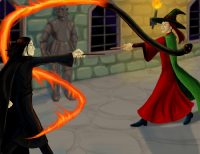
This is no moot point. Quite contrary to what many a reader may think, duels such as those in the Harry Potter books are not frequent in fantasy literature. That is so because it’s very difficult to convey to the audience or to the readers the precise impression of a thrilling duel in the terms J. K. Rowling has done. Nonetheless, many different solutions have been proposed to the question: how would two wizards fight?
- One of the most innovative responses has been employed in one of the many fictional stories about King Arthur, T.H. White’s novel The Sword in the Stone, which inspired Disney’s animated film about the king in his early days. In the film adaptation of T. H. White’s tale, Merlin is forced to struggle with Madam Mim, an evil witch at least as powerful as the great magus. The duel is extremely creative: instead of casting spells, each combatant tries to attack their foe in the form of an animal. Therefore, it’s not a question of who is the most powerful, it’s simply a war of intellects and quick-thinking. Predictably, Merlin wins by transforming himself into germs which cause Madam Mim—who is in the form of an old British beast, an aullay—to die almost instantly.
- In some comics, wizards confront one another by means of sending a single beam of power against their opponents. The beams collide and the winner is the one who can manage to cause their beam to reach the adversary and subdue him. Needless to say, this kind of duel is utterly monotonous.
- In a late 1980s film Willow, the fight between witches at the end is almost purely physical instead of magical, except for one instance of levitation. The winner is the one who manages to snatch the other’s wand.
Of course, there are RPG wizard duels, but as far as I know, each player has his or her turn to strike and it’s up to the dice if he’s going to hit or miss the opponent. Some authors, like Tolkien, simply choose not to resort to proper duels. When Gandalf repels the balrog, the latter can’t strike back because his powers don’t involve spell magic.
The reason for the difficulty in depicting convincing duels in the fashion Rowling does is quite simple and can be drawn from muggle analogies. The first of them are western films. Duels with guns last a bare few seconds. The champion is the faster draw or the one with the best aim. That is so because it’s impossible to dodge a bullet from the moment it has been shot. Neural impulses do not travel so fast.
Most essays on this site admit that magic is a form of energy. I agree, but it is by no means ordinary as long as muggle forms of pure energy travel at light speed. It follows that, regardless of how powerful your enemy is—say, Voldemort—if you were face to face with him and you managed to cast a spell before he did, his being stronger wouldn’t matter: he wouldn’t be able to dodge, deflect, or shield himself against it. The same happens with laser pistols in sci-fi films. Once the ray, bullet, or spell leaves, they travel too fast to allow a reaction from the target. Duels would be as boring as they are in muggle world.
So we must admit that, for duels to work properly in Harry’s world, there must be time for a wizard to see what is coming, to think of a defence, and to employ it—almost a second’s time of brain processing. At light speed, the spell would have already reached the moon.
Not surprisingly, in OP35, OP36 duels in the Department of Mysteries are much like fencing or throwing things at each other: people have time to duck, to warn someone there’s a spell coming, to predict what the enemy is up to, and to react faster, even to elbow someone away. Malfoy has time to deflect Bellatrix Lestrange’s spell. She, in her turn, can deflect a jinx from Dumbledore while running away from him. I like to think that magic in Rowling’s books, although described as flows of sparks most of the time, are not usual energy. A good speed to ascribe to them is that of a ball, a basket-, foot- or volleyball. Sometimes, as in the books, they’re so fast you only have time to duck, while at other times you can stop and consider: “Should I try a shield charm or deflect it?”
Surely, Rowling’s magic seems pretty material rather than energetic: streams of light do not interfere with each other except for very specific situations. You can’t deflect the light of a torch, can you? In Harry Potter’s world, they collide, bounce, make you hair stand up while they pass by you. That’s why the distance between both parties in a duel matters. I believe that only spells such as Lumos involve pure energy, and they are of little use in a duel. Wingardium Leviosa, Alohomora, and the Imperius and Cruciatus Curses also seem to be almost instantaneous, but it appears that to cause permanent or long-lasting physical damage the spell needs to be somewhat material as well.
Those effects can’t even be associated with a single state of matter. Only solid things bounce, but only gaseous things can make your hair stand up. This idea matches well with another previously stated elsewhere in this site: magic is a form of energy that can be interconverted with matter at will. Magic is just something different; it’s not energy, solid, liquid or gas, but it can manifest itself as any of them. Examples of this behavior:
- When the fake Moody demonstrates Avada Kedavra for the first time, it is described as something enormous that crosses the room;
- In book 4, Harry’s and Malfoy’s spells deflected themselves mutually, hitting Goyle and Hermione;
- Dumbledore’s spell in OP36 elicited a gong note on Voldemort’s shield;
- in the DA’s Expelliarmus lesson, the wrong spells are described as gusts of wind passing through the person to whom they were intended.
One can say: “well, then between a muggle with a gun and a wizard, I would bet in the muggle”. Not necessarily. As one essay in this site has already stated, there seems to be a natural, magical protection against muggle accidents in that world. If a car crash would never have killed Lily and James Potter (PS4), why would a gun kill a wizard? Most certainly they would change their course and avoid him. It’s possible to physically hurt a wizard without a wand, as Harry discovered to his cost in his life with the Dursleys, but that must be because this sort of protection must only work in cases of extreme danger.
So doesn’t speed make any difference in the wizard world? I wouldn’t say so. Those wizards who are able to concentrate hard enough can cast many spells without uttering magical formulas, as we have seen in one fine piece of duelling, between Voldemort and Dumbledore (OP). That saves time and might be valuable.
Copyedited by Michele L. Worley
Commentary
Notes
The shield charm, Protego, both shields and deflects.
Pensieve (Comments)
Tags: duelling illnesses and injury literary criticism magical theory Rowling's writing
