


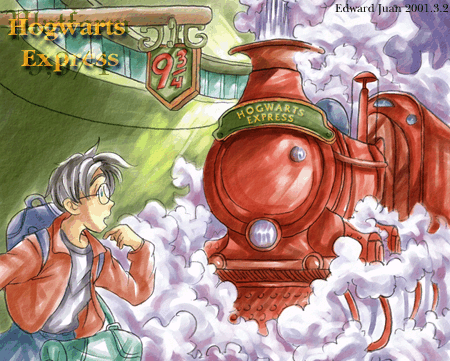
 The Hogwarts Express has been the subject of various essays exploring its nature and function. As has been plausibly noted elsewhere on this site, it isn’t really a steam engine, but rather a magical transportation device that mimics a Muggle equivalent in external form and function. This is consistent with the general trend in Wizard “technology,” which seems both to adapt itself to Muggle contemporary (or near-contemporary) norms and, in a certain sense, to progress to an increasing level of sophistication over time. The history of the broomstick described in Quidditch Through the Ages clearly demonstrates that, while the development of magical devices may not exactly parallel Muggle scientific progress, it certainly has been significant over recorded history.
Which leads to an interesting question: how did students get to Hogwarts before the invention of the steam engine?
Steam locomotion and railroads were not well-established until the nineteenth century. As an industrial superpower, Britain was an early steam locomotion leader with 6,600 miles of tracks by 1850; but even Britain had precious few a mere fifty years prior. The Hogwarts Express seems to correspond in form to the golden age of the mid- to late-nineteenth century. But what was it before, if anything?
The problem is not merely one of form: there was simply no mass transportation equivalent of the steam engine prior to the nineteenth century. Wizards certainly had other means of transportation, but most students can’t Apparate and it is implied (by Ron in Chamber of Secrets) that many adults cannot or prefer not to Apparate with other people. This leaves students with Floo powder and broomsticks, both viable means of transport. But these are individual modes of transport; why would Hogwarts make the transition to the central transportation system of the train?
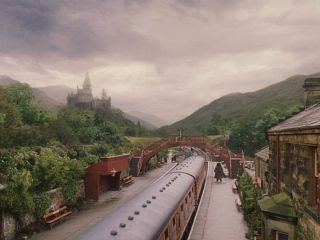 It could be argued that broomsticks became less viable over time as the concern for secrecy mounted (with the International Statute of Secrecy of 1692) and Muggle society expanded. However, it has been pointed out elsewhere that there must be some reason why students from all over Britain must report to London in order to get to Hogwarts. Whatever this reason—to provide a common experience for students, to control the arrival of students, even non-canonical magical geometrics—it is likely that some equivalent experience existed prior to the train.
Possible candidates include the other two transportation systems involved in getting to Hogwarts: the horseless carriages and the boats. Perhaps, prior to the inception of the Express, students traveled to the school in the carriages all the way from London. This would of course be quite a spectacle, but presumably no more so than a scarlet steam engine, which manages to stay out of sight well enough as it crosses most of Britain.
However, in keeping with the Wizard tendency to duplicate Muggle forms, it is not likely that the carriages would have been gathered in one place in London, as Muggle transportation wouldn’t have taken this form. Perhaps the carriages started off at various points throughout the island, joining an increasingly long procession as it made its way through Britain. Although completely hypothetical, this system seems the most likely means of transporting students en masse in a manner consistent with contemporary Muggle technology so that they would arrive on time at Hogwarts via a communal transportation experience.
While the train, like many aspects of magical pseudo-technology, seems static in form, one can’t help but wonder what form it will take in the years to come. Wizard technology seems systematically quaint, but not unrecognizably so; in general it seems to be no more than 100 years or so out of date in form. Perhaps future generations will be traveling on a “vintage” Hogwarts Express mimicking a diesel engine, or even a bullet train. The witch with the snack trolley will presumably still ply the aisles no matter what form the train takes.
Commentary
Pensieve (Comments)
Tags: carriages history magical theory train station trains transportation
