


Contents
Introduction
Defining Magic
First Attempt at a Definition of Magic
Second Attempt at a Definition of Magic
A Closer Look at Spell work
Third Attempt at a Definition of Magic
Elements of Performing Magic and Their Function
Examples of Magic
Accio: Summoning Charm
Avada Kedravra: The Killing Curse
Could Muggles Research Magic?
How Could the Muggle Science Approach Affect the Wizarding World?
Introduction
When we Muggles consider wizards’ magic, the question “How do they do it?” aims more honestly at the answer to the question “How could we do it?” The following thoughts will not enable anyone to do magic in the way J.K. Rowling describes it, but may serve as a basis for understanding that effects we call magic might be explicable in terms of mere Muggle natural sciences, especially physics and chemistry.
Defining Magic
As a good definition of the facts to be described often includes a working hypothesis, we shall try to tackle the task of this essay by definitions. The first question to be asked is, if the results of magic are impossible or only highly improbable. In the Douglas Adams novel The Hitchhiker’s Guide to the Galaxy,[1] the “infinite improbability drive” made things happen that were on the same improbabilitiy level as the one the drive was currently operating on, and so the saving of Ford Prefect and Arthur Dent, improbable as it was, nevertheless happened. A more down-to-earth approach would be the generation of a LASER beam. If one had asked a physicist of the end of the 19th century if it were possible to make matter emit photons in a synchronised way, so that they add themselves to one strong light beam with few escaping, this would have been called “extremely improbable” at best. This is now done on a regular basis in every CD-player. This leads us to a
First Attempt at a Definition of Magic: Magic is a means of willingly invoking the improbable behaviour of living or dead matter.
The idea that magic may be explicable in Muggle terms may cause many a reader to protest. But obviously, the magic of J.K. Rowling’s books works on non-magic matter, as shown repeatedly in the books: Muggle artifacts can be enchanted, Muggle memories can be modified, Muggles can be suspended in the air. So, magic actions do work in a way non-magic matter reacts to. Therefore, one can formulate a
Second Attempt at a Definition of Magic: Magical and Muggle uses of nature intersect, in the manner of a set and subset relation.
This means that the effects scientifically understood and used by Muggles are a part of the effects used, though not necessarily knowingly understood, by wizards, while the abilities of the wizarding world exceed the possibilities of the Muggle knowledge of today.
A Closer Look at Spellwork
Let us have a look at a spell to see what it is doing. Take, for example, a Summoning Charm: we see a wizard pointing a wand, speaking an incantation and the object moving. Moving means that the object has gained kinetic energy, while not necessarily losing potential energy or mass. So, where does this energy come from?
It can be either induced by the wizard or be somehow generated within the object. The latter is impossible in this case, as there seems to be no change of properties of the material within the summoned object, although it cannot be ruled out for other spells. Canon tells us a lot about energy transfer during magic. The Avada Kedavra (AK) curse is accompanied by a green light arc, Stunners by red ones. There can be sound, if a spell is performed (again, AK may serve as an example). Also we hear that Muggle electronics do not function in the presence of magic (GF28). All these phenomena can be explained, by a
Third Attempt at a Definition of Magic (the process of performing magic): Magic is effected by a transfer of electromagnetic energy from the spell caster to the object of the spell and possibly back. This transferred energy either activates the effect itself or induces the activation of the effect.
For the following discussions, we must assume the wave model of energy, meaning that each energy quantum is an electromagnetic wave of a certain frequency, the energy of the quantum being proportional to the frequency it has. Energy can be transferred to an object if parts of this object are able to absorb or to resonate with the frequency of the transferred energy quanta. As an example, consider the heating of water by a microwave oven. The microwaves resonate with the hydrogen-oxygen bonds in the water (or other molecules that have O-H bonds as well), so that the atoms in this bond begin to swing like two balls connected by a spring. Other frequencies than the resonance frequency of this spring will not activate the swinging process and molecules having no chemical bonds able to resonate to the special frequency of the microwave will remain unaffected by the microwaves (for example, polyethylene molecules, which have no O-H bonds) and remain cold.
To achieve the intended effect, the energy transferred has to be very specific. It has to activate certain atoms/molecules that are the target and and not interfere with other atoms. As shown with the example of microwaves above, such processes are possible.
Elements of Performing Magic and Their Function
The trait of magic ability seems to be hereditary within mankind. Its genetic basis seems to be complex and based on recessive genes. This is shown by the fact that Muggle-born wizards are possible and occurr on a regular basis, while Squibs are very rare. A possible definition of magical ability, understood as a physical capacity of humans, is
The ability to perform magic is the ability to activate purpose-fitting energy spectra within one’s body and to transfer them to the object via appropriate means.
Let’s now analyze which parts of the wizard’s body and which objects are involved in performing a spell and which function they fulfill. The image below may serve as a model. We see a wizard cast a spell, the wand emits the spell energy, as seen by a light jet between wand and object, and the object reacts.
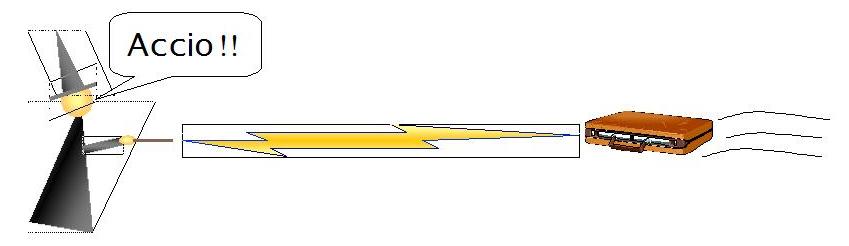
So, the following elements are part of performing magic:
- The wizard’s brain and body
- The wand (not necessary)
- The object.
The wizard’s brain defines the intent and releases the information for the energy spectrum to be transferred. The release of the correct energy is connected with a special formula either to be spoken in a certain rhythm, melody and pronounciation (see Wingardium Leviosa in Harry Potter and the Philosopher’s Stone) or just to be thought with great concentration (wordless magic in Harry Potter and the Half-Blood Prince). This formula either activates this intent-fitting energy spectrum by itself or is just a resonating, learned formula that a wizard learns to connect with the release the appropriate energy. For evidence of the latter theory, we might note that the incantations known to us are intent-fitting words in languages understood in the culture of the wizarding society of Great Britain. Other cultures will surely have their own incantations, intelligible to them. But that is not written down in canon.
Wizards needing to speak the incantation need to speak the incantation correctly, otherwise it does not release the right energy and has no effect, or it results in unintended effects (for example, the Barufio incident in (PS10), or Neville’s inability to cast effective spells with his broken nose in (OP35)). More powerful wizards ( = wizards able to focus their minds better?) can release the right energy without speaking.
A problem to be solved is why the magic energy flowing through the wizard does not affect sensitive molecules within the wizard (self-absorption problem). This may be explained by assuming that the energy pattern itself is formed in the fingertips or the eyes of the spell-caster. (Wandless spells needing eye contact seem to indicate that this is a possible means of magical energy transportation, too.)
The wand resonates with the energies released from the wizard´s body and amplifies them like an antenna. This may explain why certain wands operate better with certain wizards, if one assumes some sort of modulation of spell frequencies on a carrier, like sound frequencies modulated on a radio wave for transmission. Similarly, special aptitudes for certain branches of magic, as indicated by Ollivander in (PS5), might be explained by assuming that certain branches of magic use special frequency bands, and that certain wands resonate better at those frequencies than others.
The object resonates in total or in parts with the energy coming in and reacts accordingly. The resulting effect is: magic.
It is difficult to assess from canon whether sound and light effects occurring with the execution of a spell have any function. We know such effects occur (for example, a green jet and a sharp, swooshing sound for AK (PS2, GF1), a red jet for Stunners (OP31)). Light and sound effects connected with certain spells indicate the energy transfer, but need not be functional parts of the effect. Possibly, they are harmonic or subharmonic waves of the effective frequencies. Or one may assume that these effects are by-products of the necessary energies for these spells without a function of their own (like harmonic waves). But this is in no way sure.
Examples of Magic
To illustrate the theory sketched above, let’s consider the mechanism of two spells.
Accio: Summoning Charm
This charm has to solve two functions. It has to make an object rise from the ground and it has to give it kinetic energy and a direction. This applies for Accio as well as for Banishing Charms, broomstick flying or—without the neccessity of giving the object speed and direction—levitation.
An object lays on the ground and has weight because graviation pulls it towards the centre of the earth. The nature of gravitation is not yet clear to physicists, but it can be visualised as being an exchange of energy that is proportional to the mass of the bodies. The energy quanta exchanged are called gravitons and may, as may other subatomic particles, be seen as an electromagnetic wave as well as a particle. Since with every particle there is associated an anti-particle, to make an object fly, to levitate it (cause the object to act in an manner that is anti-gravity), may be possible by creating anti-gravitons. (Roger Highfield has given some examples of how Muggles tried to do so[2]).
The motion may be explained by synchronized Brownian Motion, emission of particles or similar mechanisms.
Avada Kedravra: The Killing Curse
The result of this curse is instant death leaving no traces visible in a normal post-mortem. It seems to be a command to “Stop living.” The theory that this is accomplished by draining so much energy from the victim that this unfortunate dies from instant undercooling is implausible, because undercooling leaves traces, characteristic internal bleedings. Another theory assumes vasovagal shock, a sudden drop of blood pressure leading to heart stoppage, as a mechanism for this curse. A person suffering vasovagal shock loses consciousness instantly, but the brain functions die slower. So the victim suffers instantaneous heart death, but could be revived if treated with heart massage. However, spiders, who have no vasovagal system, are affected (GF14). So, this rules out this mechanism, too.
Another possible mechanism is altering all neurotransmitting substances, leading to an end of all bodily activities, including brain activities. This death would be instantaneous and traceless, if any autopsy performed included no attempt to determine the concentration of possibly active neurotransmitters in the cells of an AK victim. In order to effect this, just very specific chemical bonds would have to be altered, which could be done with one specific energy, that resonates with these specific chemical bonds. This works on beings without a vasovagal system as well, so this seems to be the best explanation at this time.
Could Muggles Research Magic?
Taking up the thread from the beginning of this essay, the question originally posed: if we Muggles could learn magic by looking at it from the physical point of view, would it be possible for Muggles to create machines that could perform spells?
The main problem is finding a cooperative wizard for one’s research. Muggles have created receivers and analysers for nearly every frequency range, from far infrasound over sound, radio waves, and microwaves, to X-rays or gamma rays. So once a willing wizard or witch was found, analysing the energy spectrum of any spells cast should pose only a few challenging but manageable technical problems. Like a parrot, one could then repeat a particular spell once its mechanism had been identified in this fashion, but it is doubtful that even if a manner of reproducing a particular instance of a spell could be developed, that any method could be developed by which Muggles could apply the spell generally in other situations.
How Could the Muggle Science Approach Affect the Wizarding World?
Finally, the question is: Can the wizarding world benefit by using Muggle approaches to magic? We know that there are a lot of unsolved problems in the wizarding world—from curing werewolf bites to blocking Avada Kedavra. Understanding the nature of these magical effects in terms of Muggle physics and chemistry might make it easier to create countermeasures. So—Hogwarts needs a science teacher!
The author would like to acknowledge all the contibutors to threads on the Harry Potter Lexicon Forum discussing magical theory, especially those known under the following screen names: Mattew Bates, Ari, Nine, Istari Jones, Hermione Potter, Denise S., Kathy Lynch, Buckbeat, Cliff Hamaker, Saralinda, Meg L., Pinky, Olivia Wood, Derby Nastyface, Maré, Elanor, Caius Marcius, Amy Z., Paul. Dionne, and Lisa Inman.
Notes
[1] Douglas Adams, The Hitchhiker’s Guide to the Galaxy, German translation, Ullstein 22491, Frankfurt / Berlin 1995.
[2] Roger Highfield, The Science of Harry Potter, Viking, Harmondworth 2002.