A - B - C - D - E - F - G - H - I - J - K - L - M - N - O - P - Q - R - S - T - U - V - W - X - Y - Z - named |
|---|
V
vampire - Veela - Vipertooth, Peruvian
vampire 
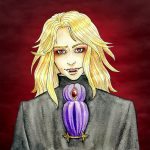
Vampires are similar to humans except that they feed on blood. Though not wizards themselves, vampires are able to mix somewhat in the Wizarding world – they occasionally attend social events (HBP16) and products like blood-flavoured lollipops are marketed for them (PA10) – but a close watch has to be kept to ensure they don’t attack innocent bystanders (HBP16, DP2, DP3, DP4). Generally speaking, though, they seem to be feared by wizards. Lockhart bragged about subduing a vampire in one of his books (CS10), for example. Vampires are studied in Defence Against the Dark Arts (CS10, PA3, PA14, GF10). (from The Lexicon page 317).
Harry has seen pictures of vampires in Defence Against the Dark Arts, but had never "met" one before Slughorn's Christmas party in his sixth year; their appearance is described as pale and gaunt (PA3).
-
Treatment of vampires is regulated by the Ministry of Magic; they seem to be classified as "non-wizard part-humans" (GF10).
-
They are hated and feared by many. One of the boys trying to impress the veela at the Quidditch World Cup claimed to be a famous vampire hunter (GF9).
-
Garlic is used against vampires (PS8), though exactly how might be a little complicated (PA10).
-
They are associated with Romania and Transylvania (PS8, QA).
-
Quirrell had encountered them in the Black Forest (PS5)
-
Hagrid had a "sligh' disagreement with a vampire in a pub in Minsk" while on his journey to visit the giants (summer 1995) (OP20)
Thanks to Pippin for help with this list.
Veela 
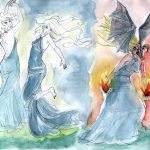
Female magical beings that have the ability to drive men uncontrollably wild, especially when they ‘turn on’ their charm or perform the sensual dance for which they’re known (GF8, GF22). However, when they get angry, they turn into bird-like creatures which throw fire. A group of veela served as the mascots for the Bulgarian National Quidditch Team at the Quidditch World Cup, though they were kicked out when they distracted the referee (GF8). Veela hairs can be used as wand cores (GF18). Fleur Delacour is part veela; her wand's core is a hair from the head of her grandmother, a veela. There are no male veela (JKR). (from The Lexicon page 319).
The veela are based on a number of sources that describe Eastern European nature spirits of legend:
-
"Vily" are Slovic fairies who can take the form of birds.
-
"Vilas," as they appear in Serbian legends, are "mountain nymphs, young and beautiful, clad in white, with long flowing hair. Their voices are said to resemble those of woodpeckers. They shoot, according to popular belief, deadly arrows at men, and sometimes carry off children..." (
The Fairy Mythology by Thomas Keightley, 1878.) -
The book
A Field Guide to the Little People describes the Vily
(singular: Vila) in detail. They are nature guardians, caring for the trees,
streams, and flowers in their domains. They are extremely jealous of
beautiful women. Their moods are as changeable as the weather and they can
both cause and cure illnesses. A human who tarries too long in their
territory may be shot dead with arrows or die suddenly from heart attack,
lumbago, or by being buried under an avalanche. Vily have fair complexions
and curly, reddish-brown hair which falls to their feet. They wear
shimmering white clothing or coverings of green leaves. Interestingly, those
born on Tuesday or Sunday can most easily see Vily.
Vipertooth, Peruvian
XXXXX - Peru
See Dragons - Peruvian Vipertooth.
A - B - C - D - E - F - G - H - I - J - K - L - M - N - O - P - Q - R - S - T - U - V - W - X - Y - Z - named |
|---|