


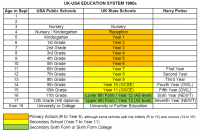
Some American fans have raised the issue of being confused about the British education system. I am a Brit who is exactly the same age as JKR (a mere 5 weeks older) so I can explain, step by step, British schooling as we both knew it in the 1970s. Obviously there were some changes by the 1990s, when JKR was a teacher and Harry was at Hogwarts.
The School Day
The day begins at 9 in the morning and ends at 4 in the afternoon. This is surprisingly inflexible throughout the country, although Infants Schools do end at 3 or 3:30.
Up to 2 hours of that time may be in various breaks—at least an hour for lunch, a recess (called either “recess” or “break”) in the morning, and perhaps another recess in the afternoon too, depending on timetabling constraints.
The Academic Year
All the information below needs to be adjusted for weekends, bank holidays and moveable feasts. Saturday and Sunday school just don’t happen in Britain.
The school year has three terms.
The academic year begins on 1 September. Usually only the teachers would work on this day, and the children would return on the Tuesday, Wednesday or Thursday nearest to 2nd September. This fits with the timing of the Hogwarts Express. The Autumn Term ends around 20 December, on a Wednesday, Thursday or Friday.
Christmas holidays last for two weeks.
The so-called Spring Term begins on Tuesday, Wednesday or Thursday around 3-5 January. The length of the Spring Term depends on the date of Easter, which of course falls on the first Sunday on or after the first full moon on or after 21 March. The last day of the Spring Term is the Friday before Good Friday.
Easter holidays last for two weeks. (I don’t know why so many American fans assume it’s only one—it’s definitely two!)
The Summer Term begins, obviously, on the Monday after Hock Monday. It ends on Wednesday, Thursday or Friday, around 18 July.
Summer holidays last for just over 6 weeks, catching the warmest and driest of the British weather. Seaside holidays are usually taken in August, with Cornwall, Brighton, and Blackpool being popular destinations.
Each of the three terms takes a “half-term holiday” in the middle. The exact date of the half-term holiday varies regionally. It’s usually for a week in the Autumn Term and in the longer of the other two terms, but only a Monday and a Friday in the shortest term.
The autumn half-term falls around Hallowe’en, but please note that this festival is not a major deal in Britain the way it is in the USA—only neo-Pagans and JKR seem to celebrate it in a big way! The plot constraints would make it difficult for JKR to throw a half-term holiday over Hallowe’en, so she seems to have suppressed all half-terms, and added those two weeks onto the summer holidays. Hogwarts seems to end its academic year in early July, or even in late June, and take 8 or even 9 weeks for its summer break.
School Throughout Childhood
It is compulsory to be educated either by regular attendance at school or otherwise (such as home schooling) from the Autumn Term immediately after your fifth birthday until the Easter or Summer holidays (depending when your birthday falls) immediately after your sixteenth.
There are two types of school, Primary and Secondary.
Primary School is usually sub-divided into Infant and Junior school. The two schools would be in two different buildings under two different head teachers, but they would be on the same block of land, have the same name (e.g. Footrot Flats Infants, Footrot Flats Juniors), and collaborate closely.
Infant School legally only lasts two years, age 5 to age 7. In practice, almost everyone starts school up to a year before it’s legally required, so many children are in full-time school from age 4. So the three classes in an Infant School are called Reception (age 4-5; some children don’t start until the Spring or Summer term, depending on birthdays); Middles (age 5-6) and Tops (age 6-7). By the end of Infant school, everyone would be literate – or else the teachers would be concerned about your “literacy problem” and recommend you for remedial reading classes.
Recently there has been quite a demand for Nursery classes (for children age 3-4), so these are often tacked onto an Infant school. They are optional, and would probably be for mornings only, or for only three days of the week.
Junior School always lasts four years (age 7-11). The classes are known, unimaginatively, as First Year, Second Year, Third Year and Fourth Year! The main subjects are Maths and English, with some social studies, science, P.E., music and crafts thrown in.
Secondary School lasts for seven years (age 11-18) (just like Hogwarts), but only the first five years are legally compulsory. Children under 16 are unlikely to “drop out of high school” in Britain, since this is against the law. Leaving at age 16 is not considered “dropping out” because it is the usual school leaving age – even now, when there is a huge push to “send everyone to university”, only about 30% of the students remain at school for Sixth and Seventh year. (For a weird reason that I don’t understand, Seventh Year is almost never called Seventh Year—it’s called the Upper Sixth!!)
School Exams
Most schools, even Junior schools, would set exams at least once a year. My junior school set maths and English exams EVERY term, and my secondary school set them twice, at Christmas and in June.
However, these exams actually do not have much formal significance. You can’t really “fail a year” even if you fail every exam. It’s unusual in Britain for anyone to repeat a year because there is a strong push to keep all the students together with their agemates. So Marcus Flint would have been an exceptionally stupid case.
Public Exams
The public exams are different—they are set by the education boards for every school in the local area. These exams do have formal significance. There are basically three of them:
- Secondary school entrance exams. These are sat voluntarily by children in Fourth Year Juniors who wish to enter grammar school. A grammar school is a specialised school that acts as a feeder for universities—it concentrates on academics to the exclusion of practical subjects. Because there are increasingly fewer grammar schools, competition is stiff—only the top 5% or so of the population would have any chance of passing the entrance exam. And it’s not the kind of exam for which you can prepare, it’s more like an IQ test. So, Hermione would almost certainly have passed such an exam—imagine how her parents felt when she never went to grammar school!
- End-of-Fifth-Year exams. In the 1970s these were called Ordinary Levels (“O Levels”), so the Hogwarts O.W.L.s are a direct parody. JKR and I both took our O Levels in June 1981 when were were nearly 16. They are now called the GCSE (General Certificate of School Education) but we won’t go into the why of this change to the system.You can take as many or few O Levels as your school and your ability will allow. For example, The Princess of Wales sat for four and failed them all. Universities require all entrants to have passed at least five O Levels, including one in maths and one in English. This is a minimum—students like Harry and Ron (who are quite bright even if they do fool around) would be more likely to take 9 or 10. While there is no legal maximum, there would be timetabling problems with taking more than 10 subjects. Twelve would be about the most that anyone would ever sit: Percy’s feat is indeed an impressive one.Note that you can’t pass or fail school—you can only pass or fail your O levels! It doesn’t matter much if you fail an individual subject—that subject just doesn’t appear on your record. Once you have passed your O Levels, you have basic qualifications, so it would be usual to leave school and find a job or an apprenticeship.British law allows 16-year-olds to take a job, rent a house (if they can afford it), smoke tobacco, have sex, and move out of their parents’ home—and parental consent is not needed for any of this. Oddly enough, however, you do need your parents’ consent to leave school or get married—it’s difficult to see how this law could be enforced in some cases. You can’t apply for a driver’s licence until you are 17. And you can’t vote, drink alcohol, or marry or leave school without parental approval until you are 18. The students who are headed for an academic career remain at school.
- End-of-Seventh-Year exams. These are called Advanced Levels (“A Levels”) and the Hogwarts N.E.W.T.s are their direct parody. They are the required qualification for university entry. Universities only require passes in two subjects, but students would usually take 3 or 4. (Five would be an exceptional showing.) There are no compulsory requirements, since, of course, A Level students have already passed maths and English at O Level. Students would take the subjects most relevant to their future university career, e.g. maths, biology and chemistry if they intended to study medicine; or look at JKR’s A Level career in English, French and German.
Public Schools
Non-Brits become confused about what we mean by a “public” school. It basically means a non-government school that is financed by fees paid by the parents. I think only about 5% of the population would attend a public school—it’s too expensive for most families, and often there is no educational advantage since so many of the state schools provide such a good education.
So if fee-paying schools are “public”, what do the British mean by “private” education? This is what is now called “home-schooling”! In the eighteenth and nineteenth centuries, children who were “privately” educated were those who had a tutor or governess living in their home. Public schools were “public” because anyone was allowed to go to them (provided, of course, they could pay).
University
It usually takes three years to complete a Bachelor’s degree at a British university. There are exceptions: medicine, for example, takes six years.
Note that we don’t have “graduate schools” in medicine and law. Students begin their studies in these fields at undergraduate level, as soon as they have left secondary school. So you would typically begin your articles in law at the age of 21, or your medical internship at age 24.
How old is Hermione?
I’ve mentioned that the British system is relatively inflexible about keeping students with their age-mates. Normally, yes, every student in a given class will have the same birthday between 1 September and 31 August. I even knew of one boy who was found out to have completed Fourth Year Juniors a year too early (his birthday was 3 September, and he had been pushed up to become the youngest person in the class above instead of the oldest person in his own class), so the local education board forced him to repeat Fourth Year before he was allowed to progress to secondary school, even though he had no problems with academic progress or social maturity!
However, the rule is not absolutely absolute. I personally knew of two exceptions. One girl was very ill in her seventh year at secondary school. She hadn’t learned enough to have a reasonable chance in her A levels, so the school allowed her to repeat her seventh year. Another girl was extremely bright. She was allowed to start secondary school (a grammar school, too!) in the September before her 11th birthday, which fell in November.
So it’s possible that McGonagall’s magical quill can identify the very able students, and that those with Autumn birthdays are allowed to enter Hogwarts a year early.
Final Note
The Scottish system (covering about 10% of the British population) is fairly independent of the English/Welsh system, and there are differences in the dates of terms and holidays. However, JKR has very obviously followed the English system in her Harry Potter stories, despite the fact that Hogwarts is apparently somewhere near Inverness.