


Magic in the Harry Potter universe is as far as we know considered to be supernatural, and has as little to do with science as ghosts and flying broomsticks. However, the fact that magic runs in families means that it is a hereditary trait. Add to that the exceptions of half-bloods, Muggle-borns and Squibs and the temptation to analyze its hereditability in terms of Mendelian genetics becomes almost unbearable (for some of us anyway). Hence, in the following paragraph I will attempt to understand how magic is inherited, how to explain the exceptions of Muggle-borns and Squibs and the political implications of this understanding in the wizarding world. My suggestion is that understanding how magic is inherited is crucial to understanding Voldemort’s ideology and aims as well as the folk tradition of regarding “pure wizarding blood” as more valuable than that with Muggle heritage. To simplify I have made the presupposition that magic is the result of ONE gene (or rather one pair of genes) alone. This may of course not be the case. Should there be more than one gene, it is my firm belief that it would not destroy the argument—merely add more words to it.
In order to find out how magic is inherited, the first question we need to ask is whether the allele (gene variant) for magic is dominant or recessive.[1] We can assume that it is either one or the other because magic seems to be a trait that you either have or you don’t. Generally and popularly speaking we all have a pair of genes (one from our mother and one from our father) for every trait we exhibit (phenotype). Now the variant of each gene is called an allele. Some of these alleles are dominant, others recessive. As an example you may have an allele for blue eyes and one for brown (genotype) on your gene pair for eye-colour, but both your eyes are brown and not blue, because the gene for brown eyes is the dominant one. Only when both of the genes are “blue-eyed” do you develop blue eyes. Got that? OK, let us move on to the magic.
Suppose first that the magic gene is the dominant one, and let’s label the magic gene “A” and the Muggle gene “a.” A magic gene alone or in combination with a Muggle gene produces a magical phenotype. This would mean that all parents with two alleles for magic (AA) would have magical children (AA or Aa) regardless of whether the other parent was magic (AA or Aa) or Muggle (aa). This explains why half-bloods seem to be magical more often than not. By half-blood, I mean a 1st generation half-blood, the child of one Muggle and one magical parent. Because the allele for magic is dominant (A) it is possible to be magical and still retain a recessive allele for Muggleness (a).
In the event that both parents had the genotype Aa (that is, each parent was magical with a recessive Muggle gene) their children would have a 75% chance of developing magical abilities (see Figure 1 below). In other words their children have a 25% probability of becoming Squibs. Hence, Squibs should normally not appear in pure-blooded families. In the event that they do, they may be the result of either rare mutations or illicit extramarital love affairs. If one parent in addition is Muggle (aa) the child would only have a 50% chance of being magical. We have not heard much about half-blood Squibs/Muggles in the books so far, but that may be because they, having a Muggle parent, are better adjusted to the Muggle world.
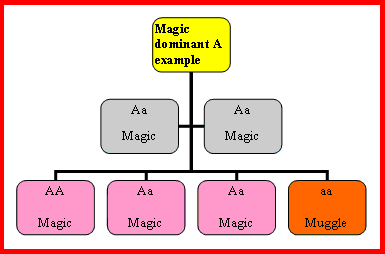
Figure 1.
This seems all well and good. What this theory doesn’t explain, however, is the Muggle-borns, the witches and wizards born from two Muggle parents. Two Muggles should strictly speaking only be able to produce children of the same genotype as themselves (aa), who would then turn out to be Muggles too. There is of course the chance that the Muggle-borns too may be the result of random mutations and extramarital affairs. The fact that Muggle-borns seem to be more common than Squibs, could simply be the result of there being more Muggles around than there are wizards and witches. After all, the vast majority of Muggles have Muggle children even in the Harry Potter universe.
Now forget everything you’ve read for a moment and consider the possibility that magic is a recessive trait. The situation would then be completely reversed. Two magic parents (aa) would always have magical children (aa) regardless of their heritage. Squibs would then be extremely rare and only occur in events of mutations even in “half-blood” families. Children born to one magical (aa) and one Muggle parent carrying a recessive magical gene (Aa) would then have only 50% chance of developing magical abilities (see Figure 2 below). On the other hand, magic could be preserved in generations of Muggles as an invisible trait and suddenly make its appearance in so-called Muggle-borns. The children of two Muggle parents with magical blood (that is, Muggles with an Aa genotype) would have a 25% chance of becoming magical.
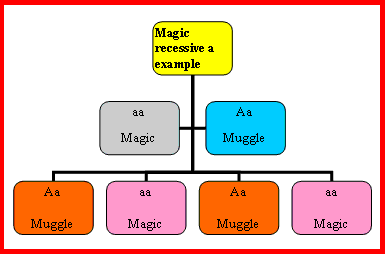
Figure 2.
Both these ways of inheritance seem somehow plausible: while the first one accounts for Squibs and the magic in half-bloods, the second explains the large number of Muggle-borns.
There is however a more political aspect to all this talk about magic heritage and genetics. As everyone who read the Harry Potter books knows (and if you didn’t I’m impressed you’ve read this far), some pure-blood wizards and witches are rather obsessed with staying pure. The reason for this is presumably that they want to preserve the magic ability within the family. Now, suppose you are a pure-blooded wizard or witch who wants to do just that. If magic is a recessive trait, then marrying and having children with a Muggle will certainly impair the chances of your family staying magical for the next generation. However, having children with a Muggle-born witch or wizard will not threaten the family’s magic in any way, because he or she is just as pure as you are. You can infer this because his or her magical abilities depend on his or her having the same aa genotype as the one you yourself have. Conversely, if the magic trait is dominant mingling with Muggles poses a small threat to magic ability for your children. However, the ultimate threat to magic in your descendants may be greater. By coupling with Muggles in successive generations you may eliminate the magic gene completely without being given much prior warning in the form of your children and grandchildren lacking magic abilities. Moreover, it is not just Muggles that pose a threat. Muggle-borns and half-bloods too are likely to, if not “dilute your blood”, to borrow an expression from the Death Eater propaganda, at least decrease the number of people with two magic alleles on their gene-pair and thus increase the chances of successive generations facing a massive outbreak of “Squib-epidemic”.
In other words, while both the dominant and recessive theories are likely from a purely scientific point of view, the anthropological evidence of political viewpoints among members of the magical community seems to point in the direction of magic being a dominant trait. The resentment and suspicion of anyone with Muggle heritage may not have so much to do with a lack of belief in their magical ability, but in a fear of the unconscious threat these people pose to the ultimate survival of the magical community. Thus Mr. Hagrid’s argument against pure-blood elitism (CS7)—that the Muggle-born Ms. Granger is a more promising witch than pure-blooded Mr. Longbottom is strictly speaking irrelevant to the real issue at hand—resonates on both a cultural and scientific level. Of course, emotion is also a force to be reckoned with, and pure-blood pride (or occasionally shame) is evident, such as in Mr. Malfoy’s disappointment that a Muggle-born had a better school report than his son.
This brings us to the question of how aware people are of the workings of genes in the distribution of magical abilities, and how much of the ideology is based simply on rumours, prejudice and old habits. All the talk about “blood” suggests the latter, but I do suspect that wizarding eugenics is more refined science than it seems from young Harry Potter’s point of view. However, knowing whether or not the prejudices are precisely and scientifically articulated in people’s minds is not necessarily crucial to understand the motivation for their existence. The habits and ideology of the pure-bloods may well be a direct result of the magic genes acting through cultural evolution. After all, what is a more logical base instinct for a gene than to ensure its own reproduction?
It seems important to stress at this point, that this is not in any way intended as an expression of sympathies towards Voldemort. None of this justifies the corruption of the Ministry of Magic or the killing of innocent people. It is my opinion, like many others’ that (apart from the entertainment value this offers to Muggle literature) it is extremely unfortunate that some of the pure-blood wizards and witches have gone to such extreme, violent and undemocratic measures to achieve their goals. I am not however, going to take any stance on the question of whether or not these goals are ethical, logical or indeed relevant at all. This is partly because I find myself still wanting for a precise and unbiased statement of said goals, and partly because the point of this essay is not to take a particular political or moral stance, but to present a theory what could possibly be the other side of the story that is told to Harry Potter, and to us through his point of view.
One of Voldemort’s aims seems to be to preserve wizardkind, a goal that is not in itself necessarily unethical or irrational. Nonetheless, there are plenty of irrational feelings involved, which resemble the racism found in Muggle societies. For example, violent protest actions like attacks on Muggles hardly accomplish anything relating to mere preservation of wizardkind. Apart from image building as The Evil Overlord, they hardly seem to have any purpose whatsoever. But if simple preservation of wizardkind is the goal, those who hold it may rationally consider discrimination against people with Muggle heritage an unfortunate but necessary measure. Ministry policies like banning Muggle-born children from attending Hogwarts might reduce the number of Muggle alleles in wizarding society and thus increase the survival chances of magic as a trait. This is in no way an ideal solution, and it leaves several questions unanswered such as: what to do with the Muggle-born magicians if they do not learn to control their magic? Also one of the weightiest arguments against extremist pure-blood elitism is that inbreeding could lead to heaps of other less fortunate genetic results, but that is outside the scope of this essay.
Because it may be rational to seek to preserve wizardkind, the possibility of ethical motives operating alongside discriminatory motives in Voldemort and his followers should not be discounted. Therefore, the popular comparison between Voldemort and Adolph Hitler is justified on many counts, but not on all, and I feel the need to address the main points of divergence between the two.[*]
First of all Voldemort is the leader of a minority within a minority. His aim as far as genetics and racism go is to protect and preserve the small wizard population in a Britain predominantly inhabited by Muggles. Hitler on the other hand, was a leader of a majority, the white Christian Germans, attacking a minority, the Jews (and the gypsies and homosexuals and communists and disabled, but for the sake of the argument, let’s concentrate on the Jews for now). To take this further Hitler could just as easily be compared to a paranoid Muggle who thought he had spotted a wizard conspiracy against his people. Voldemort on the other hand would be better compared to an extremist Jewish leader who is against marrying and mingling with gentiles and is reluctant to accept converts. Such policies have existed more or less throughout the history of Judaism, and may be one reason why the Jews still exist as a people, the term “people” understood to mean an ethnic and genetically similar group. In this vein, I can think of several ways in which Slytherins resemble the Jews, not so much in the way they act as in the ways they are characterized by those seeking to disparage them—as cunning, ambitious, untrustworthy and keeping to themselves.
Of course, there is a second important difference that has to do with the nature of magic as a special quality that visibly and practically distinguishes wizards and witches from Muggles. There is no evidence that a similarly obvious ability or genetic trait should distinguish Jews from European gentiles. It somehow makes more sense from an objective point of view to preserve a small minority population with the ability to do magic, than to preserve a majority people with no special qualities and with no obvious threat, genetic or otherwise, against them. Again, this does in no way justify Voldemort’s actions, but it does lend a small scrap of understanding, as to why anyone at all would agree with him. From reading the books about Harry Potter we are left with the impression that he is simply a megalomaniac with crackpot ideas, but if that was all there was to it, it would be very unlikely for respected members of society to support him like they do.
To conclude this rather long line of reasoning, let us first sum up the main points. It seems likely that magic is inherited genetically. If there is only one gene for the ability to do magic, it could be either recessive or dominant. However, the theory that magic is a dominant trait seems more likely since the prevalence of pure-blood elitism may very well have its genesis in a rational desire to preserve the magic gene in the wizarding population. If magic was recessive, then Muggle-borns and half-bloods would pose no threat to the wizarding gene pool. However, if magic is a dominant trait, Muggle heritage may indeed result in more Squibs in the community after some generations of intermarriage.
In other words the seemingly racist, unethical and irrational ideology of Voldemort and the pure-blood elitists may have a grain of sense in it after all, considered as a means of preserving the genetic heritage of wizardkind. This explains why Voldemort gains support among so many people—and also explains why he doesn’t. Harry Potter and his non-pure-blood school chums, simply have no context for understanding what is going on and why. This is very unfortunate because as already mentioned the wizarding population is already very small and it might not be able to afford another large war. In other words, if any wizards and witches are going to come out of the war victorious, it is time to start speaking the same language. It is time to unite the houses at Hogwarts, to paraphrase the Sorting Hat. It is time for Dumbledore to set aside his Olympian view of things long enough give the students the knowledge they deserve to understand those they may disagree with. While understanding your enemy may well lead you to agree with him, it also gives you more ammunition against him as well as a higher probability of reaching a compromise.
[*] For the record, this essay is not intended to be anti-Semitic, anti-Slytherin, anti-German, anti-Muggle or anti-anything else. In short it is not intended to offend anyone, and if in spite of my noble intentions, you are in any way offended, please leave a comment and I promise to address your concerns.
Commentary
Notes
JKR on her  website has written "Squibs are rare; magic is a dominant and resilient gene." Note further that the link provided is to an archive of jkrowling.com, which was superseded by Pottermore.
Pensieve (Comments)
Tags: genetics half-blood magical ability magical theory muggle-born prejudice