


“An immensely complex spell involving the magical concealment of a secret inside a single, living soul. The information is hidden inside the chosen person, or Secret-Keeper, and is henceforth impossible to find—unless, of course, the Secret-Keeper chooses to divulge it. As long as the Secret-Keeper refused to speak, You-Know-Who could search the village where Lily and James were staying for years and never find them, not even if he had his nose pressed against their sitting room window!”
-- Professor Flitwick (PA10)
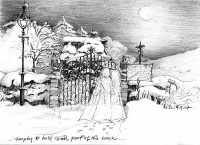
This is the first explanation of the Fidelius Charm we ever encounter in the Harry Potter books. While it might seem satisfactory at first glance, it clearly raises a lot more questions than it answers (as do many other plot elements in Rowling’s saga).
Is the charm cast on people, or on a specific location? What would have happened if the Potters left Godric’s Hollow? What happens to the people who have known the secret before the charm has been cast—do they forget what they knew, or are they simply unable to tell what they know to anyone? Could the Death Eaters who knew once where to find number twelve, Grimmauld Place locate the house, and if so—could they enter? And what would have they seen there? . . . How could Hagrid rescue Harry, if he wasn’t in on the secret? And how did Dumbledore even know where to send him? Most importantly—when and how does the charm stop working? And that’s just the beginning.
I will try to present answers to (at least) some of these questions, as I see them.
But let us start with the facts we know for certain:
- A secret is concealed inside a single soul—the Secret Keeper’s.[*]
- The only people who know the secret are those whom the Secret Keeper has told directly, but none of them is able to pass on the information. Only the Secret Keeper can do that.
- The Secret Keeper can tell the secret in writing—like Dumbledore’s note to Harry in Order of the Phoenix.
- The death of the Secret Keeper doesn’t affect the secret’s status in any way.
- The subjects of the secret themselves cannot tell the secret to anybody, and they cannot be forced to tell it.
 Those are the general facts known to us from Prisoner of Azkaban, Order of the Phoenix, and J. K. Rowling’s website. They are the basis of any assumption or question we should ask ourselves about the charm. But there are quite a few facts of a different kind—let’s call them “circumstantial facts.” They may help us understand what’s this Fidelius Charm is all about, but we should treat them with extreme caution, so as not to make unsupported assumptions. Here they are:
- Peter Pettigrew was the Secret Keeper for the Potters location (JKR says that explicitly on her website, and Flitwick’s explanation supports this).
- Hagrid found the Potters’ house in ruins, and was able to take Harry out of there.
- When Hagrid picked Harry up he “didn’t know [Sirius Black]’d bin Lily an’ James’s Secret-Keeper.” As Sirius really wasn’t the Secret Keeper, we can deduce that Hagrid didn’t know the identity of the real Secret Keeper. That probably means that Hagrid has never heard the secret from the Secret Keeper himself, in person—otherwise, he should have known that Sirius was (or actually, wasn’t) the Secret Keeper.
- Dumbledore was Secret Keeper for the Order of the Phoenix, and nobody could have found Headquarters unless he told them personally where it is.
- Harry couldn’t see number twelve, Grimmauld Place before he read Dumbledore’s note, which said: “The Headquarters of the Order of the Phoenix may be found at number twelve, Grimmauld Place, London.”
- Number twelve, Grimmauld Place was made Unplottable by the Order of the Phoenix, but they weren’t sure if this (and other) enchantment would still hold if the house had passed to the ownership of Bellatrix Lestrange.
So, what can we make up from all of this? I will now try to analyze each of the two situations of the Fidelius Charm that we know about, starting with the second (which I believe is less complicated).
The Fidelius Charm on number twelve, Grimmauld Place
The first question we must ask ourselves is—what was the subject of the charm?
It seems, at first, that the subject was the house itself—as Harry couldn’t see it (compare this to Flitwick’s “had his nose pressed against their sitting room’s window”, which implies that the house could be seen—but I’m getting ahead of myself). But then, why would you even need to make the house Unplottable—you can’t find it anyway, unless you know it’s there. Also, why would the ownership of the house even matter?
So, maybe the subject of the charm was the fact of the Headquarters’ being inside the house? The house was then made Unplottable to make it harder to find, and yet—Bellatrix must have been in that house in her childhood, she should have known where it is without any map at all. . . . Also, in that case, Harry should have been able to see house from the beginning.
Problematic, isn’t it? Here’s my theory: The caster of the Fidelius Charm was Sirius Black, who was the only one allowed making the house a secret, as he was its owner. Furthermore, the secret was combined of two things—the house itself, and the location of the Headquarters inside it. That way, either you know that the house exists and that the HQ is located there, or you know nothing at all. This also explains why Sirius’s death was considered a problem—the house was no longer his, so he couldn’t keep it a secret. And, in this case Harry really couldn’t have seen the house before being let in on the secret. The Unplottability of the house was, I believe, a mere precaution (that might be the weak point of my theory, I admit).
Two important points should be emphasized (with the note that they are not factual, but my interpretations):
Firstly, I think you cannot make a secret of something that is not yours—otherwise, it would be very easy (if you know how to do the charm) to hide things that do not belong to you, and obviously, it is very problematic for those whose property you hide. It makes sense if the charm “doesn’t allow” it.
Secondly, one crucial question needs to be asked—what happens with the death of the charm’s caster? That question will become even more important as we look on the first Fidelius Charm situation. Let’s move on to it, then.
The Fidelius Charm on the Potters’ home in Godric’s Hollow
Here, as I already mentioned, it is pretty clear from Rowling’s words that the subject of the secret was the Potters’ being inside the specific house where they were hiding. But one thing (at the very least) still remains a mystery—How did Hagrid find baby Harry? As far as we see, he was never told the secret, otherwise he should have known something about the Secret Keeper’s identity—or at least that there was one. The answer to this question also explains a lot of other things.
To make a long story short, I believe there are two possible answers:
- The death of the charm’s caster stops the charm from working. Who was the caster in this situation? Well, to follow the idea that the secret must “belong” to you, it had to be one of the Potters themselves. It probably was Lily, as we know she was supposed to be good in Charms (her wand tells us that much), but it doesn’t make a lot of difference if it was James.So, when Voldemort killed Lily, the charm was no longer active. Everybody can see the ruins, and see little Harry inside. That theory goes along well with the second Fidelius Charm situation, and the Order’s fear that their HQ could be found afterSirius died.
- There is the possibility that once the house was ruined, the charm was cancelled, because the secret was no longer true—the Potters weren’t hiding in that specific house anymore, because that house “ceased to exist,” so to speak.Moreover, I believe that while alive, if the Potters would have left the house, they also wouldn’t be protected, as the secret they were trying to keep wasn’t true in that case too. It’s the same thing really—either they leave the house, or the house “leaves” them, and the secret is no longer valid.
Which of these theories is the correct one (if at all)? I honestly don’t know. Both have their pros and cons, both seem plausible enough to me, and both explain how Hagrid could see Harry when he came to take him away.
But a few more questions remain yet unanswered.
How did Dumbledore know where to send Hagrid? Well, aside from the fact that he sent him when the secret was no longer kept, the house in which the Potters were hiding wasn’t secret at all—it was their being inside it that was the secret. Dumbledore could have (and probably had) known the house itself—it’s just that if he visited the house while the Potters were still alive, he couldn’t have seen them at all (unless he was told by Peter, of course). I believe that to an outsider, who didn’t know the secret, the house would have appeared to be empty.
What happens to the people who have known the secret before the charm has been cast? I don’t think that they forget what they knew, per se, or at least they don’t realize that there’s something they don’t remember. Bellatrix and Narcissa, for example, probably still have their memories of being in number twelve, Grimmauld Place (given that they have visited there, of course), but they are unable to figure out where it’s located, or find it in any way, or recognize the place if they stumble accidentally on that street. They can’t even try to remember it, because they are unaware of the fact that they’re missing something.
Finally, when and how does the charm stop working? As I’ve said before, I think it happens either when the caster dies, or when the secret isn’t true anymore (I’m not sure if in case of the latter, the secret is still kept when it becomes true once again). And, of course, there surely is a counter-charm that the original caster can use to undo the Fidelius Charm’s effects.
Those were a few of my thoughts on the intriguing subject of the Fidelius Charm. I’m looking forward to see them proved or disproved (of course, the former would be preferable) in the final book of the series, which we will hopefully read soon (keep your fingers crossed until then!).
[*] Note: both the spellings “Secret Keeper” and “Secret-Keeper” appear in the Harry Potter books (see “Potterwords” on this site).
Commentary
Pensieve (Comments)
Tags: betrayal broken hidden hiding houses safehouse safety soul traitor