


From 4 June to 1 July 2006, I was in London, to improve and practice my English, see what’s going on elsewhere, meet new people, etc. I also took the occasion to have a look at some places related to Harry Potter, in the books as in the films. Because of my investigations, I’ve been able to better understand the Platform Nine and Three-Quarters descriptions in King’s Cross Station, among other things.
1. King’s Cross and Platform Nine and Three-Quarters
St. Pancras
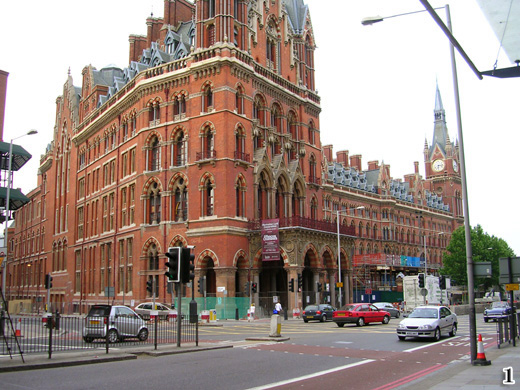
1. Those who well know the Harry Potter films probably recognize this facade. But it’s not King’s Cross, it’s St. Pancras! This large building is the work of Sir George Gilbert Scott and was built during 1865 to 1877 in pure Neo-Gothic style. The station itself occupies only a small part of the building (and the platforms are behind), the rest having been used in the past as the “station hotel,” quite common in Europe. The “Midland Grand Hotel” was left abandoned for years (and it surely was the case during the CS/f shooting), but this has at last been reconsidered and the building is now being restored and refurnished as a five-star hotel and quite luxurious apartments, as the “St Pancras Chambers,” its original name. The interior was used in some films, such as Batman Begins, when Batman summons bats to hide the salvage of Rachel (see some pictures of the inside, before restoration).
Ford Anglia parking spot
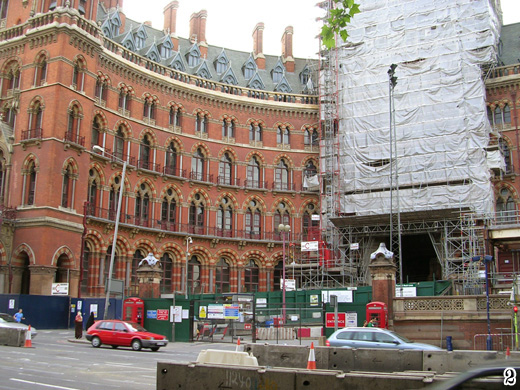
2. In the beginning of CS/f, the Weasleys’ Ford Anglia was parked somewhere behind the left phone booth. We can’t recognize the big entrance seen in the film since the scaffolds hide it.
King’s Cross Station
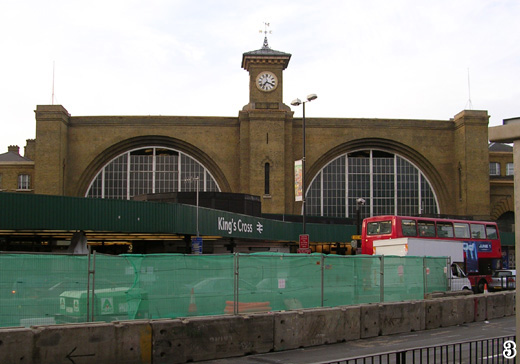
3. King’s Cross Station is just beside St. Pancras, beyond the clock tower Ron and Harry pass round with the Ford Anglia in a CS/f deleted scene. King’s Cross is less beautiful, that’s why CS/f shows St. Pancras instead, which could get the viewer mistaken if he doesn’t know the place. As I hinted, a huge renovation is in process in the surroundings of the two stations, that’s why I’ve been unable to see the whole St. Pancras facade.

King’s Cross footbridge
4. Here’s the footbridge leaning over the main King’s Cross platforms (1 to 8) taken by Harryand Hagrid in PS/f. In the movie, we can see the platforms through the grids, but actually they’re hidden behind fiberglass plates, for security, I suppose. They seem to have been there for a long time and therefore have been taken off for the film needs, then put back.
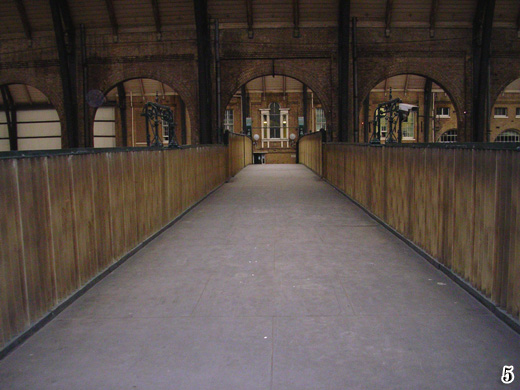
King’s Cross footbridge – inside
5. The same footbridge seen from the inside, walked on by Daniel Radcliffe(Harry) and Robbie Coltrane (Hagrid) 5 years ago. To be honest, it’s not as nice as is seems in reality.
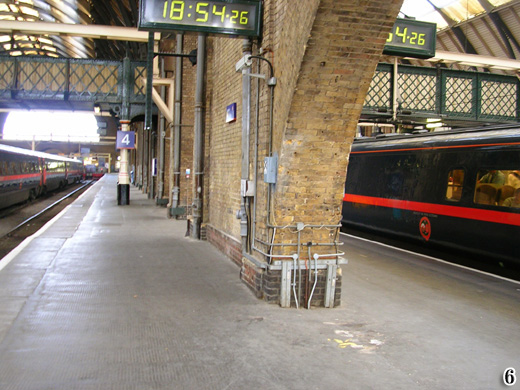
King’s Cross platforms 4 and 5
6. Here are the platforms 4 and 5 used for the movies. Compared to PS/f for instance, my picture is oriented the wrong way, since the shots don’t show the footbridge when the wizards go through the wall. Furthermore, the pillar has been enlarged, for it’s much less wide than the trolleys used by Harry and the Weasleys.
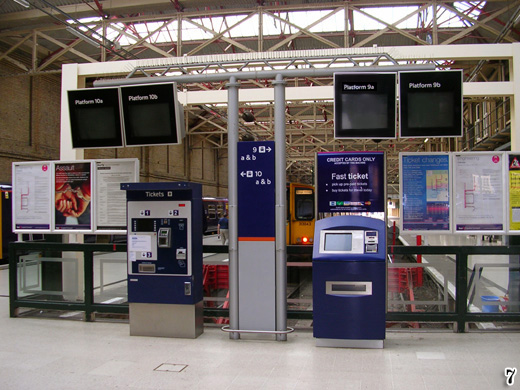
King’s Cross platforms 9 and 10
7. Here are platforms 9 and 10 (9a and b, 10a and b), in a smaller building (located on the left on picture #3) coupled with the main building. Beyond these platforms we have the 11th and last track, on the far left.
It’s time to read again some book excerpts :
“Not to worry,” she said. “All you have to do is walk straight at the barrier between platforms nine and ten. Don’t stop and don’t be scared you’ll crash into it, that’s very important. Best do it at a bit of a run if you’re nervous. Go on, go now before Ron.”
“Er—okay,” said Harry.
He pushed his trolley around and stared at the barrier. It looked very solid.
He started to walk toward it. People jostled him on their way to platforms nine and ten. Harry walked more quickly. He was going to smash right into that barrier and then he’d be in trouble —leaning forward on his cart, he broke into a heavy run —the barrier was coming nearer and nearer—he wouldn’t be able to stop —the cart was out of control —he was a foot away—he closed his eyes ready for the crash— . . .
(PS6)
Harry had caught the Hogwarts Express the previous year. The tricky part was getting onto platform nine and three-quarters, which wasn’t visible to the Muggle eye. What you had to do was walk through the solid barrier dividing platforms nine and ten. It didn’t hurt, but it had to be done carefully so that none of the Muggles noticed you vanishing.
(CS5)
Unless it has completely changed since 1991, the look of the platforms 9 and 10 doesn’t fit at all with the descriptions. One can’t find a barrier, and anyway we’d need a platform between the two tracks to allow the existence of a “barrier between platforms nine and ten,” it would make sense. Why is it wrong? Because Rowling was thinking about Euston Station when she wrote the first book, but this detail doesn’t resolve our problems—I’ll get back to that later (HPM).
King’s Cross barrier between tracks
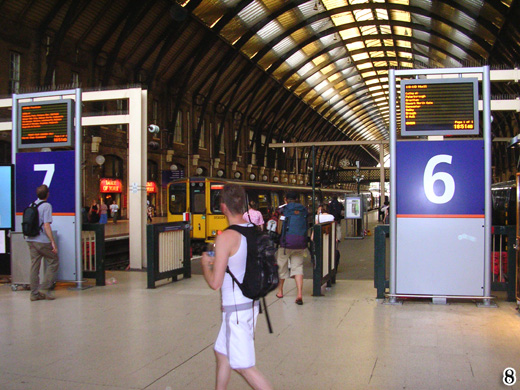
8. Back in the main King’s Cross building, we find an arrangement that works much better. There’s a long (and “solid”) barrier placed perpendicularly to the tracks, each two tracks both sharing a platform. We can pass by the two little barriers located left and right or by the bigger one, in the centre (through which the wizards would pass). Sometimes they’re closed a few minutes before the train leaves, to avoid delays. If Rowling had said for instance “Platform 6 3/4,” it could have worked, if we imagine that they have to pass through the closed central barrier.
Platform 9¾
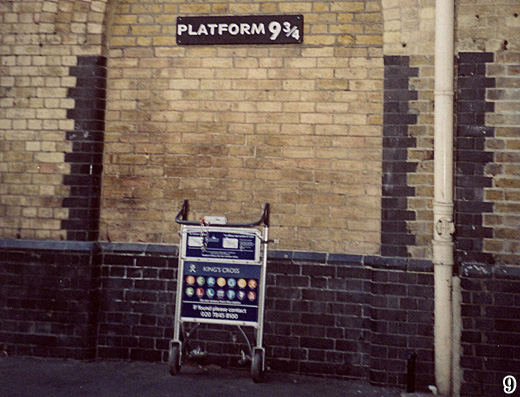
9. The little building where are located the platforms 9, 10 and 11 has its own entrance, of course smaller than the main entrance. When you use that entrance to get out, you discover on the right a small arch beneath which is hanged a sign displaying “Platform Nine and Three-Quarters,” itself leaning over a trolley which seems to be stuck into the wall (it has been cut, of course). Tourists like to pretend pushing the trolley through the wall for a picture. Of course, the location of this trolley is incorrect, and no one knows where to put it, since Rowling made a mistake herself! (Note: this picture comes from the Internet, it’s not mine—I deleted mine accidentally.)
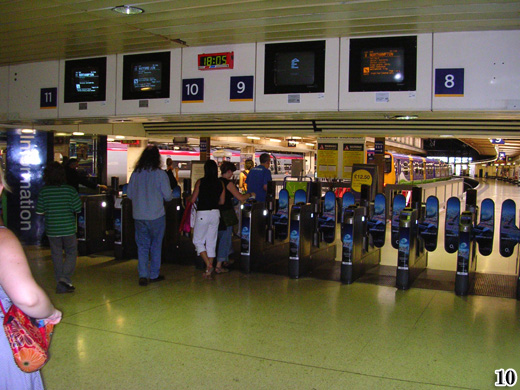
Euston Station
10. Here I am facing the Euston station platforms 9 and 10. Rowling was thinking about this station while writing PS. It’s very close to St. Pancras and King’s Cross. Here, platforms 9 and 10 are also bound together as in King’s Cross, though here the platforms are located on the opposite side. Barriers block the access to the platforms : only passengers with a valid ticket can pass, after showing it to the person in charge. maybe these barriers were added recently; if they were already there during the writing of PS (early 90’s), maybe Rowling imagined the wizards traversing them to get to Platform Nine and Three-Quarters.
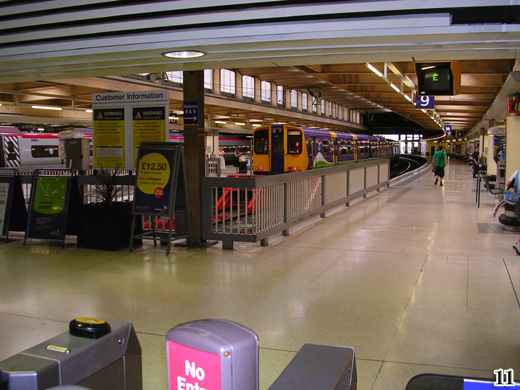
Euston Station Platform 9
11. After a closer look, we find another barrier surrounding the end of the tracks. Maybe the wizards could pass that way, even if this barrier is not properly located “between platforms nine and ten.”
In brief, even if Rowling said that she was thinking about Euston station during the writing, it’s the King’s Cross’ platform 1 to 8 arrangement that fits the best (q.v. photo 8). And Euston is much less charming, being more recent.
Related pages
- Platform Nine and Three-Quarters
- Map of Platform Nine and Three-Quarters
- The Hogwarts Express
2. Other places from the books
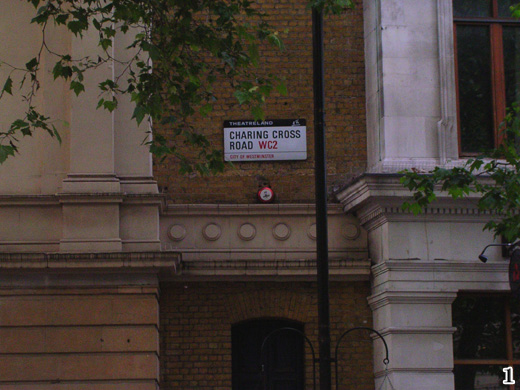
Charing Cross Road
1. The Leaky Cauldron is supposed to be located on Charing Cross Road, between a big book shop and a record shop (PS5). This street is known for its second-hand book shops, but I didn’t find a book shop and a record shop welded together (but in 15 years, everything can change). And even if I had found what I was looking for, I wouldn’t have been able to see the unplottable Leaky Cauldron, or I would have remembered I had something important to do.
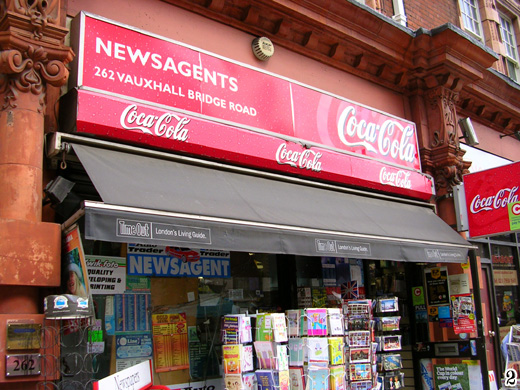
Vauxhall Road
2. Tom Riddle bought his diary on Vauxhall Road, which doesn’t exist. But Vauxhall Bridge Road does exist, not far from Tate Britain and Buckingham Palace. I was even able to find there a book shop. Let’s imagine it already existed in the early 1940s and that the future Lord Voldemort came in to buy what would become his first Horcrux.
3. Movies’ shooting locations
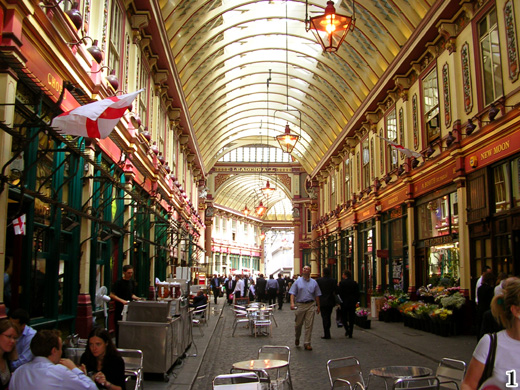
Leadenhall Market
1. Here’s the beautiful Leadenhall Market, in the City. It was used as a set for PS/f, when Hagrid and Harry go to the Leaky Cauldron. This London neighbourhood is quite far from the centre, and therefore of Charing Cross Road. The shop located beside the Leaky Cauldron was transformed into a bookshop for the movie, to fit the books, more or less. I don’t have any picture of this particular spot, for I just forgot that this market was seen in PS/f. I went there by chance! There’s a crossroad in the middle of the market (in the centre of the picture), where the four main streets cross each other; it’s in the right-hand one we see Hagrid and Harry going towards the Leaky Cauldron.
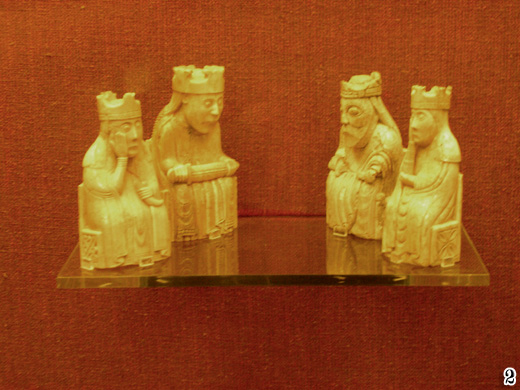
Lewis Chessmen
2. Here’s an portion of the “Lewis Chessmen,” chess pieces found in the Outer Hebrides, Scotland, around 1831. They are from c. 1150-1200 AD and were probably made in Norway. They are made of walrus ivory and whales teeth. They were found in the Isle of Lewis dunes and probably belonged to a merchant travelling from Norway to Ireland. It seems likely that there are enough pieces (though some are missing) for four distinct sets. Their general condition is excellent and they don’t seem to have been used much, if at all.
Did you recognize them? Yes, there are the ones which served as models for the wizard chess seen in PS/f. Eleven pieces are in Edinburgh at the National Museum of Scotland, eighty-two are in the British Museum. Their height is around 10 cm max., so the board would have measured 82 cm across. Thanks to Harry Potter, they’re quite famous in the British Museum. The museum shops don’t lack of derived products related to them (Harry Potter complete chess sets, chocolate pieces, books, etc.).
(source : British Museum official website, providing much better pictures)

Lambeth Bridge
3. Here I am on Lambeth Bridge, located between Westminster Bridge and Vauxhall Bridge (evoked before). It can been seen on the general London view in the beginning of PS/f, with Big Ben and the Houses of Parliament in the background. In the beginning of PA/f, the Knight Bus uses it when it has to “flatten” to prevent itself for crashing into the two other buses coming the other way.
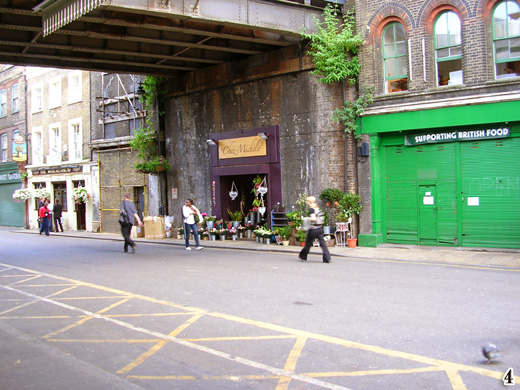
4. Here we are now in Borough Market, Southwark, not far from Tower Bridge. This is a small reputed London neighbourhood, where a market is held every day. And the good thing is that it’s not full of tourists (much rather the opposite). The entrance of this French florist (“Chez Michèle”), located beneath the railway, was used in PA/f as the entrance of the Leaky Cauldron, completely different from the PS/f one. As we can see, it was heavily modified, as long with the right-hand shop, transformed into a book shop to vaguely fit the books descriptions, as for PS/f. Again, this location is quite far from the centre, and therefore from Charing Cross Road. It was chosen rather for aesthethic matters. If the crew never filmed on Charing Cross Road, it is probably for budget and planning reasons (it’s an important and quite busy street).
Oddly, Harry’s room is located above the right-hand library (he can see the market through his window, with the railway on the right). The set of the tavern strictly speaking is almost the same as PS/f; it’s above all much brighter.
5. The London Zoo was used as a set for the beginning of PS/f and is located in Regents Park, north-centre of London, but was closed when I wanted to visit it.
6. The Australia House (the Australia embassy) entrance hall, on the verge of the West End, was used as the set of Gringotts in PS/f, but photography is forbidden. I was just allowed to have a quick look.
Commentary
Notes
Added captions to images.