


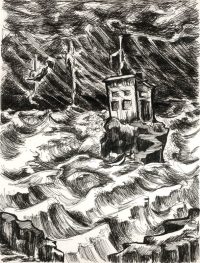
The Hut-on-the-Rock holds a key place in the life story of Harry Potter. It was here, on his eleventh birthday, that he encountered the world of wizardry for the first time since infancy. But where was it?
The address on the letter brought by Hagrid in PS4 is not very helpful: Harry Potter, The Floor, Hut-on-the-Rock, The Sea. But there are several clues in PS3 to PS5 which narrow the field down considerably.
The Rock
Firstly, what description do we have of the rock itself? It is a “large rock, way out to sea, (and) perched on top was the most miserable little shack you could imagine.” Although there are many offshore rocks that answer the description—the rocks off Lands End or St. David’s Head for example—harbours and large offshore rocks are rarely neighbours—the rocks would make the area hazardous to ships.
One interesting point about this rock is what is not mentioned. Such a rock, some way offshore and near a harbour would be a hazard to shipping. Many such rocks have a rather larger building on them than a mean little shack—namely a lighthouse! The absence of one from this rock will eliminate a number of otherwise promising possibilities.
How far from the shore is the rock? There are three factors to consider here, all of which limit the distance. Firstly, both the rock and the hut are visible from the shore. Now, the distance to the horizon is given by the formula:
Distance to the horizon (in nautical miles) = 1.17 times the square root of the height of your eye (in feet) (If you prefer metric, using height in metres and distance in km, the multiplier is 3.7).
For someone of average height, eye level is about 5 feet from the ground, which makes the horizon about two-and-a-half miles away. (When they first see the rock, they are looking down at the boat, so they can see further, but the rock must still be visible from the boat if they are to row to it.)
The rock could be seen from further away if it were high enough, (an extra twenty feet would roughly double the distance) but as “spray from the high waves splattered the walls of the hut,” and the hut is perched on top of the rock, it cannot be very high.
Moreover, it would be very difficult to see something as small as a two-roomed hut from much further than two miles away. In good lighting conditions, a person with 20/20 vision should be able to resolve detail subtending an angle of 1 minute of arc (1/60 of a degree). This is the equivalent of resolving detail of 3 feet at a distance of two miles (30cm at a distance of 1km). It would have to be much closer to be recognisable as a building. (Try looking out of a third-floor window for one of the plastic houses used in the board game “Monopoly” lying in the road!) Less than perfect contrast between the hut and the background, and the poor lighting conditions (it is raining) would further reduce the distance from which the hut could be seen.
One further factor has to be borne in mind: Vernon Dursley is not particularly fit, and yet he manages to row a boat with three passengers out to the rock. Even if he manages to bully one of the others into taking an oar, and even if they get help from the tide, I doubt that they could manage to get much more than a mile in the heavy seas described.
So, the rock is actually quite close inshore, almost certainly within a couple of miles of the shore, and probably much closer.
What Region?
Although Uncle Vernon spends most of Sunday and Monday driving the family to the seaside town from where they row to the rock, they need not be as far as two days’ drive from Surrey—Uncle Vernon had no specific destination in mind when he set out, and he doubled back on himself several times—“every now and then he would take a sharp turning and drive in the opposite direction, muttering ‘Shake ’em off, shake ’em off’” (PS3).
Let us now look at Harry and Hagrid’s departure from the rock. They leave after daybreak (which is about 5am in late July) and use the boat to get back to land, where they arrive at a seaside town from where they take a train to London, arriving in time to visit Diagon Alley (PS5). The train is very interesting, as it restricts the search considerably. Unless you are in the far north and west of Scotland, it is possible to get to London by mid-afternoon from almost any station in Britain, but outside of south east England, there are only a small number of railway stations in seaside towns. Can we limit our search any more?
In my previous essay “In Search of Little Whinging” I suggested that Harry’s journey from London’s Paddington station later that day, “back to the Dursleys,” is a red herring in identifying Little Whinging. Note the absence of an apostrophe—he is going to the family, not the house. If the Dursleys are not at home, Harry can’t go there—he is not trusted in the house on his own (otherwise he would not have had to spoil Dudley’s birthday treat by being taken with them), and even at the age of fifteen he is locked in his room if they go out without him (OP3), so he certainly won’t have a key. And of course, we have good reason to suppose the Dursleys are not at home on the afternoon of July 31st! They were last seen just after midnight, retreating into the back room of the Hut-on-the-Rock. Although they were not seen when Harry and Hagrid left the hut at daybreak, the presence of the boat indicates the Dursleys had not left before then, and as Hagrid took the boat they could not leave afterwards until someone came to rescue them. The whole point of going to the Hut-on-the-Rock was to avoid communication: Vernon would have made absolutely sure there was no telephone (fixed or mobile) or any other means of communication with the shore, and that the tide was not going to go out far enough to allow a postman to reach them simply by walking across the beach. Consequently, it would be a long while before they would be able to set off home, and indeed probably had to remain in the hut until Harry raised the alarm. So the departure from Paddington station indicates the location of the Hut-on-the-Rock, not that of Little Whinging. The rock must be off the coast of that part of Great Britain served from Paddington station, namely South-West England and South Wales. The coastlines of South Wales and South-West England are heavily indented, and in total are about a thousand miles long, from Exmouth all the way round to Fishguard.
Of the thirty or so seaside towns along this coast which have railway stations, only a very few fit the description in the book. When Hagrid and Harry arrived at the station “there was a train to London in five minutes” (PS5). The use of “to,” rather than “for” suggests it was a probably a direct train, but this is not certain.
A brief tour of South Wales and the West Country
Many towns on the coast , such as Torquay (of “Fawlty Towers” fame), Plymouth, Swansea, and Cardiff are simply too big to be described as “small seaside towns.” Others, like Barnstaple, Milford Haven and Pembroke, are a long way up estuaries, with no view out to sea. Fishguard can be ruled out because it only has two trains a day, connecting with the ferries from Ireland, and they run at 1:30am and 1:30 pm (the most regular train service in the country!): as Harry and Hagrid left the hut after daybreak, the first train they could get from Fishguard would not be until lunchtime, and it would not get them to London until 6:30pm, a little late to go shopping. Even if it was late-night opening in Diagon Alley on July 31st, they had less than two hours before Harry had to be back at Paddington for the only train that would get him back to Fishguard that evening!
There are promising-looking rocks off the coast at Tenby (Caldey Island), Looe (St. George’s Island) and Weston-super-Mare (Flat Holm and Steep Holm), but they are much bigger (and further away) than they seem: Caldey Island and St. George’s Island are both inhabited and there are substantial buildings on the other two, for the use of visitors to the nature reserves. Other rocks, for instance in the Kidwelly area and at Par, are accessible at low tide, which would not suit Vernon Dursley’s purpose.
There are several rocks marked on the map in Mounts Bay, near Penzance, but they are all submerged at high tide (except St. Michael’s Mount, which is both inhabited and connected to the mainland by a causeway).
My search eventually narrowed down to five possibilities.
The Shortlist
- The first possibility is the Severn Estuary between Caldicot (on the Welsh side) and Severn Beach, (on the English side). This is not very far from Tutshill, where JKR lived as a child. At this point the Severn estuary is several miles wide but very shallow, and there are a very large number of exposed rocks. Since the events in Harry Potter and the Philosopher’s Stone, supposedly taking place in 1991, the area has been changed dramatically by the construction of the “Second Severn Crossing,” (Wikipedia) which was built between 1992 and 1996. It is quite possible that, in 1991, a temporary hut might have been erected on these rocks for preliminary work on this project. Neither Caldicot nor Severn Beach have direct train services to London—from Severn Beach it is necessary to change trains in Bristol, whilst Caldicot is on a cross-country route.
- Further down the Somerset coast, past Weston-Super-Mare (birthpace of John Cleese (another Fawlty Towers connection) and Arthur C. Clarke), is Burnham-on-Sea. Out in the Bristol Channel from Burnham there are several islands, in particular Stert Island, a nature reserve with a wooden observation tower, which is about a mile and a half off shore, although this is a more of a dune than a rock, or possibly the Chisel Rocks, about a mile and a half out. There is an annual swimming race from Burnham to Stert Island. The local station for Burnham is Highbridge. I’m not enough of an anorak to have a copy of the 1991 timetable, but at the time of writing (2006), a change of train at Bristol is usually necessary to get to London. There is in fact just one direct train to London—but the time, shortly after 7am, fits the plot very neatly!
- Continuing along the coast, there are no suitable candidates in North Devon, mainly because there are no railways, but the north Cornwall coast has three places served by railway—Newquay, Hayle, and St. Ives. Near Newquay, the Gull Rocks, in Holywell Bay, are a possibility, but they are rather close in shore, (and the book also specifically says there is only ONE rock!) It would certainly be possible for Uncle Vernon to row out there from Holywell. There is no railway at there, but Newquay, about three miles east, has a station. There are a few through trains from Newquay to London on summer Saturdays, but otherwise it is necessary to change at the junction with the main London to Penzance line. Hagrid would have no trouble rowing the three miles from the rocks to Newquay, especially since he cheats by using magic!
- Further west still, another possibility is the group of rocks off Gwithian, in St. Ives Bay. The largest, Godrevey, is uninhabited but has a lighthouse (automated in 1934) so the most promising is Bessack Rock, much smaller and about half a mile off shore. Again, Hagrid would be able to row the three miles or so to Hayle, with its harbour and its railway station (on the main line from Penzance to London).
- Rounding Lands End, I found no suitable locations in south Cornwall, so my final possibility is one of the rocks near the mouth of the River Dart in south Devon, the furthest of which, the Eastern Black Rock, is nearly a mile off shore. Dartmouth is actually about three miles up the Dart estuary, from where there is a steam-operated tourist railway to Paignton, where it meets the main line. Being geared to the tourist trade, however, it doesn’t start operating very early, so Harry and Hagrid would have quite a long wait for the first train (about 11 am in the high season timetable) if they left the rock in the early morning. The rocks are not visible from Dartmouth because of an intervening headland. Although a magic-assisted Hagrid could probably row three miles, it is probably also too far for Uncle Vernon to have rowed, and there is no obvious location nearer than that from where they could have parked the car and embarked for the rock.
The Choice
There may be other possibilities, but I think these five are the most likely. If I had to choose, I would probably guess that Bessack is the one which most closely fits the description—the direct train service from Hayle to London possibly being the clincher. However, I would welcome other people’s comments and suggestions, to see if we can narrow it down further, or perhaps suggest other rocky candidates that I have overlooked!
Commentary
Pensieve (Comments)
Tags: days and dates geography places