


“Merlin’s beard, what is Xenophilius Lovegood wearing? He looks like an omelet.”
— Great Auntie Muriel (DH8)
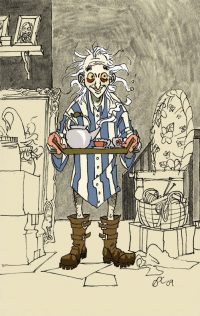
Father of Luna Lovegood; widower since c. 1990. Unusually open-minded, to the point where his paper, “The Quibbler,” is not taken seriously.
Xenophilius agreed to publish Rita Skeeter’s exclusive interview giving Harry Potter’s version of the events surrounding Voldemort’s return in June 1995 (OP25). After the Ministry of Magic and the Daily Prophet changed their tune about Voldemort’s return in June 1996, Mr. Lovegood sold the interview to the Daily Prophet for a very good price. Later, during Voldemort’s second rise in the Wizarding World, The Quibbler’s editorial policy was to steadfastly support Harry, to impress upon the Wizarding World that it’s everyone’s first duty to help Harry.
He appears to be something of a naturalist, because he apparently used the money from the sale of the Harry Potter interview to The Daily Prophet to finance a trip to Sweden with his daughter to try to catch a Crumple-Horned Snorkack (OP38), and in general his magazine seems to expend a lot of effort on stories about unusual (and probably mythological) magical beasts. He obtained what he believed to be the horn of a Crumple-Horned Snorkack, “an enormous, gray spiral horn, not unlike that of a unicorn.” Hermione recognized that this horn was in fact an Erumpent horn, a “Class B Tradeable Material” prone to “explode at the slightest touch.” Unfortunately, Hermione was right; a poorly-aimed Stunning Spell from Xenophilius hit the Erumpent horn, setting off an explosion that demolished his home.
It is from the mouth of Xenophilius that we first hear of the Deathly Hallows identified as such (DH20). Harry, Ron and Hermione go to visit Mr. Lovegood a couple of days after Christmas, 1997, to ask him to explain the the symbol he was wearing on his egg-yolk-colored cloak at the wedding of Bill Weasley and Fleur Delacour, and which Viktor Krum denounced as “Grindelvald’s sign” (DH8). Mr. Lovegood explained that the symbol, an eye circumscribed by a triangle with a single vertical line through it, was worn by believers in and seekers of the Deathly Hallows to identify themselves to one another (DH21). He encourages Hermione to read aloud from the book The Tales of the Beedle the Bard, her inheritance from Dumbledore, the “Tale of the Three Brothers,” which sets forth the myth associated with the Deathly Hallows. An in-depth discussion amongst the Trio and Xenophilius ensues, about the three Deathly Hallows, their nature, provenance and possible locations.
Xenophilius’s daughter, Luna Lovegood, was kidnapped on the Hogwarts Express on her way home for the Christmas holidays (DH25) because of what Mr. Lovegood had been writing in The Quibbler. She was imprisoned in the basement of the Malfoy mansion, joining Ollivander, who was also imprisoned there. In an attempt to ingratiate himself with her captors and secure his daughter’s release, Xenophilius summoned Death Eaters to his home hoping to exchange Harry for his daughter. The Death Eaters Travers and Selwyn failed to capture Harry, Ron and Hermione, and before the Trio’s escape Hermione used the Obliviate charm to wipe Mr. Lovegood’s memory of their visit, in anticipation of his likely interrogation by the Death Eaters.
Hermione devised for the Trio a plan of escape that allowed the Death Eaters a glimpse of Harry before they disapparated out of the ruins of Mr. Lovegood’s home. Hermione hoped that the glimpse of Harry would convince the Death Eaters they had not been summoned to the Lovegood home on a wild goose chase, and therefore inspire their leniency towards Xenophilius. Mr. Lovegood ended up captured and imprisoned, as confirmed on Potterwatch, likely incarcerated in Azkaban, a repository for Voldemort’s enemies since his take-over of the Ministry of Magic, and subsequently released at Voldemort’s fall.
Family
Spouse: Pandora Lovegood, died in an accident caused by experimental spellwork.
Children: Luna Lovegood, his only child, who shares his interest in mythical creatures.
Commentary
Etymology
Xenophilius: derived from the word “xenophile,” denoting a person attracted to that which is foreign or alien, and derived from the Greek root forms “xeno,” meaning “alien,” “strange” or “guest,” and “philia,” meaning “friendship,” “fondness,” “affection.”
Lovegood: A simple compound word, love+good, connoting the simple and true quality of their affections.
Pensieve (Comments)
Tags: Deathly Hallows Remembrall eccentric fathers gullible imaginary Luna Remembrall yellow