


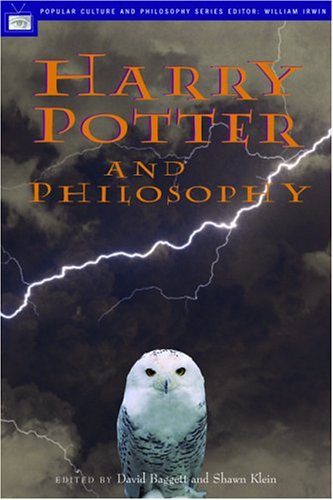
From the book Harry Potter and Philosophy: If Aristotle Ran Hogwarts.
One of the surest signs of friendship is the willingness to help out in bad times. Those who stand by us through hardship, depression, and failure will certainly be there when things are good too. Good friends are loyal and trusting and good friendships are admirable.
But it isn’t always wise to be loyal and trusting. In Chamber of Secrets, Ron’s father offers some sage advice on this topic: “Never trust anything that can think for itself, if you can’t see where it keeps its brain” (CS18). One way of interpreting this is that we should be cautious about trusting anyone (or anything) as long as we are unsure about his motivation. On the positive side, then, we should trust those who wish us well.
That’s true, but it’s not much help. If you haven’t had this experience, you probably know someone who has: you think you’re being treated well but in fact you’re not. Your friend may feel the same: he thinks you’re treating him well, but you’re not. Perhaps people in this situation are just using each other, or perhaps they’ve got some totally wrong-headed ideas about what’s good. In either case they might be right to trust each other, but this doesn’t mean that their friendship is admirable. So what exactly is it about a friendship that makes it admirable?
The Potter books provide us with an excellent opportunity to explore this question. We’ll start with some corrupt friendships, and then turn to Hagrid’s friendships for some contrast. Finally we’ll enlist the help of the Greek philosopher Aristotle to sort it all out.
Voldemort’s Agents
Towards the end of Philosopher’s Stone we learn that Voldemort, in his weakened state, had to share another’s body to survive. If ever he needed a friend, this would be the time. Enter Quirrell, who was kind enough to let Voldemort into his heart, his mind, and literally into the back of his head where the Dark Lord began recouping his strength. Quirrell’s loyalty and devotion to Voldemort was undeniable. Going about with a foul-smelling turban wrapped around your head to cover a grotesque companion is a bit inconvenient after all. And you wouldn’t kill a unicorn and drink its blood for just anybody (PS17)! Should we admire Quirrell’s loyalty and courage? At best we might admit a grudging admiration, but we would be right to see his friendship with Voldemort as corrupt.
Wormtail also makes a great sacrifice to prove his loyalty to Voldemort. To complete the Dark Lord’s rebirth, Wormtail cuts off his own hand and adds it to the giant cauldron (GF32). Earlier, he had insisted on the strength of his devotion (GF1), but he was now required to prove it. This was just as great a sacrifice as Quirrell’s, though most of us wouldn’t want to have to choose between severing our own hand and drinking unicorn blood. But in neither case should we think Voldemort’s agents were motivated exclusively, or even primarily, by a desire to help their master.
Once he has regained his full strength and the rest of his estranged followers return to him, we discover the real nature of Voldemort’s relationships. His agents are motivated by equal parts of fear and greed. When he had lost his powers, most of his supposedly loyal Death Eaters plead innocence or ignorance to avoid punishment. This sort always tries to back the winner, whoever it may be (GF9, GF33). Their loyalty is never more than a thinly disguised hope for future rewards, a show designed to advance their own ambitions. Wormtail, for example, is rewarded with a silver hand capable of crushing rock (GF33).
But there were some notable exceptions. Some Death Eaters were motivated by more than greed and fear. Not all of Voldemort’s followers abandoned him when he lost his power. The most striking example is Barty Crouch, Jr. His loyalty is motivated by respect and admiration. Unlike the other Death Eaters, Barty sees Voldemort as more than a way to advance his own ambitions. He desires a deeper connection, hoping that Voldemort will respect him in return and even love him as a son (GF35). This makes Barty’s case more interesting, and more difficult to understand. Nonetheless, Voldemort probably sees Barty as a tool or instrument that he can use to achieve his ambitions. No one would be a bit surprised ifVoldemort sacrificed Barty to get what he wanted.
Malfoy’s Cronies: Crabbe and Goyle
It’s not quite fair to offer the same account of Malfoy’s friends. The three of them are more or less on an equal footing. Crabbe and Goyle certainly don’t have Malfoy’s brains, but they, like Malfoy, are from aristocratic, well-to-do families. Although we may not find much to admire about Crabbe and Goyle, they do stick by their friend. Unlike most of Voldemort’s agents, Malfoy’s cronies aren’t motivated by greed or fear. They’re not in it for the rewards, but rather for the pleasure of hanging out with the sharp-tongued Malfoy. They obviously enjoy Malfoy’s malicious humor, and it seems that they really like him for who he is. No accounting for taste, we might say, but there it is.
What should we think of Malfoy’s friendships? The easy answer is to say they aren’t worth admiring simply because Malfoy is a nasty piece of work. But that may be too easy. Malfoy is not (yet) a hardened criminal. We may think of him, along with Crabbe and Goyle, as young lads gone wrong. Although they have had plenty of material benefits, something has gone wrong with their moral development. But in spite of this they have formed the best friendships of which they are capable.
Hagrid’s Chums: Harry, Ron, and Hermione
By contrast, consider Hagrid. If there ever were a kind-hearted shaggy giant of a friend, Hagrid is the one. The wise wizard Dumbledore trusts Hagrid with his life (PS1, PS16, CS14), as do Harry, Ron, and Hermione. But Hagrid has his faults too. He’s a bit of a blabbermouth (PS14, PS16, PA10, GF20), he sometimes loses his temper (PS4), and his love for monstrous animals produces disastrous results on more than one occasion (PS14, GF21).
For example, during Hagrid’s first lesson as Care of Magical Creatures teacher, Malfoy gets wounded by the Hippogriff, Buckbeak (PA6). The accident was Malfoy’s fault since he did not approach the creature with the proper respect, but nonetheless Hagrid was supposed to be responsible for his students. The matter is taken up by a disciplinary hearing to decide the fate of both Hagrid and the “dangerous” Hippogriff. The interesting thing about this incident, however, is not only the flaw revealed in Hagrid’s character, but the strength.
Harry, Ron, and Hermione promise to help Hagrid construct a defense for Buckbeak. But the boys get excited over Harry’s new Firebolt broom and forget all about Buckbeak.Hermione, on the other hand, works tirelessly on the defense. As the hearing approaches, Hagrid invites Harry and Ron to his hut. After they arrive, they both remember their promise to help Hagrid defend Buckbeak, and feel terrible pangs of guilt. Hagrid waves this subject away. Instead, he talks about the boys’ shabby treatment of their friend Hermione, which has caused her to cry a lot recently. First, they had snubbed Hermione because her concern over the broomstick got it confiscated for a few weeks while it was checked for curses. ThenRon gave her the cold shoulder because her cat apparently ate his rat Scabbers. Although Hagrid is terribly worried about his beloved Hippogriff, he is more concerned with the boys’ treatment of Hermione: “I gotta tell yeh, I thought you two’d value yer friend more’n broomsticks or rats. Tha’s all… She’s got her heart in the right place” (PA14).
Hagrid’s concern for Hermione’s happiness, and his concern about the boys’ mindless disregard for one of their friends, takes precedence over the boys’ neglect of Buckbeak’s defense. It’s not only Hermione who’s got her heart in the right place. This concern for the needs of another—that is, a concern for the sake of that person’s needs and not just your own – seems to be a crucial ingredient in genuinely good friendships. But what exactly does it mean? Is a good friend simply someone who has good intentions and acts on them? With the help of Aristotle, we can see that it takes quite a bit more.
Aristotle’s Friends
Even though he lived over 2300 years ago (384 to 322 B.C.E.), Aristotle somehow managed to explore just about every interesting and important philosophical question. His word is not the last on these topics—it’s nearly impossible to find the last word in philosophy—but he usually gives us valuable insights and useful ways of looking at important subjects. This is certainly the case when it comes to friendship, which Aristotle explores in great depth and detail in two books of his Nicomachean Ethics. [1]
To determine what is admirable about friendship, Aristotle starts with the claim that whenever we love someone or something, we do so because the object appears to be useful, pleasant, or good. [2] This suggests that love is a very expansive concept covering lots of different sorts of relationships. No surprise there. We can begin to narrow down the kinds of love we experience in friendship by noticing that it occurs only in relation to living things. When we say that we just love ice cream, everyone understands what we really mean is that we love to eat ice cream. It would be a bit odd if we were constantly checking the temperature of the freezer to make sure my ice cream is comfortable. We don’t wish good things for the sake of inanimate objects. But with friends, Aristotle remarks, we do wish good things for their sake, and not just for our own. [3]
So it’s not just a matter of getting pleasure or some benefit out of a relationship that matters, but wanting your friend also to get some pleasure or benefit. There is a two-way relation that is essential to friendship. This is part of what it means to have your heart in the right place. If we were to wish good things for someone who couldn’t care less about us, it would be an expression of goodwill, but not friendship. For example, if we asked Hagrid what he thought of the stranger from whom he gets the dragon’s egg in Philosopher’s Stone, Hagrid would probably say that he wished the stranger well. But it is doubtful that the stranger returns these good wishes, nor would we want to call such a relationship, a friendship. So, depending on what it is we love about our friend, we want to both give and receive pleasant, useful, or good things. Thus, Aristotle arrives at three types of friendship. Let’s explore them further.
Useful Friends and Pleasant Friends
Let’s say we love our friend, Laura, because she has an enchanted flying car and we like to go flying in it. We might hope that Laura benefits somehow from her relationship with us, but primarily what we care about is the chance to fly. So if we want to provide some benefit in return, it will be because we want to keep on flying. In that case, our intentions might be good, but our motivation is suspect. For it’s not really Laura that we care about, but rather some incidental fact about her, namely, that she has an enchanted car. Furthermore, we might not even love her anymore if she didn’t have such a car.
This is pretty much what we find going on with Voldemort, who never expresses any interest in the well being of his followers. They are merely instruments to be manipulated, punished, and rewarded insofar as they fulfill his needs. It would be totally out of character for him to be concerned about who Quirrell or Wormtail really are, except insofar as it will help to motivate them to do his bidding.
The same sort of analysis holds for friendships based on pleasure. Let’s say that we love our friend, Alex, because he has a great sense of humor. We might hope that he finds us amusing too, but primarily what we care about are the laughs we get from hanging out with him. We might even increase our own pleasure by making him laugh. But, again, we are motivated primarily by a desire for our own pleasure.
Crabbe and Goyle have this sort of relationship with Malfoy. In return, Malfoy enjoys a receptive audience for his malicious humor along with the benefit of their protection. Although we can imagine that they might genuinely like each other, it would be too much of a stretch to imagine them trying to improve each other in any worthwhile way. Perhaps at best, Malfoy might encourage his cronies to be physically fit, and they might encourage Malfoy to practice his cruel wit.
According to Aristotle, in both of these types of friendship the most distinctive quality is that we don’t really care about our friends for who they are, but rather for what they can do for us. It just happens to be Laura who has the enchanted car and Alex who has the great sense of humor, both characteristics that we value, but characteristics that could well be provided by lots of other people, even though enchanted cars are quite rare. Quirrell, Wormtail, Crabbe, and Goyle are similarly replaceable. Furthermore, Voldemort and Malfoy enjoy the benefits and pleasures resulting from their friendships regardless of whether their friends are good people. In fact, Voldemort surely knows that his friends are rotten to the core, andMalfoy probably could not care less. But they’re both getting what they want out of their friendships.
Friendship in the Fullest Sense
By contrast, in an admirable friendship, we enjoy the benefits and pleasures because we realize that our friend is a good person. What we love about a friend in this case is primarily that he is, or at least appears to be, a good person. Whatever benefits and pleasures that follow are certainly enjoyable, but they are not the basis of our friendship. In other words, we want good things for our friend, for his sake.
But we shouldn’t take this to be a completely selfless giving. Aristotle does not think that helping our friends requires ignoring our own interests. When we help a good friend, we are at the same time pursuing our own good. To see this we must expand our notion of the good from the sort that gets smaller as it is divided to the sort that increases as it is divided. Dividing it makes it more, not less. The good that Aristotle has in mind is the strength of character, or virtue, from which good actions flow. When we help a friend to strengthen his character, we have increased the amount of good available, whereas when we merely take up space in the enchanted car, we have reduced the amount of good available. Friendship in the fullest sense requires a shared understanding that what is good for a friend is also good for us. So when we strive for the good of a friend, we are also striving for our own good.
In fact, Aristotle famously remarks that a friend is another self. Just as we should love what is noble and good about ourselves, so too we should love what is noble and good in our friends. The love for a friend, understood as another self, turns out to be an extension of the appropriate sort of love of oneself.
We can see an illustration of this in Hagrid’s friendship with Harry. Hagrid identifies with Harry right from the start. Like Harry, he had lost both of his parents, and was extremely unsure about how or whether he would fit in at Hogwarts (GF24, PS5). But the identification runs deeper. Since Hagrid sees a reflection of himself in Harry, he strives to promote Harry’s well being. Hagrid takes delight in what is best in Harry’s character and does what he can to promote Harry’s further development. Even though he admits that Harry occasionally breaks the rules, Hagrid is convinced that Harry is alright (GF22), that he’s got his heart in the right place. In other words, Hagrid believes that Harry would never break the rules unless it were for the sake of some more important good. Likewise, Harry refuses to believe that Hagrid would ever intentionally harm an innocent person (CS14, PA1).
Another ringing endorsement of Hagrid’s character comes in Goblet of Fire, when his friends have to convince him to resume his position as teacher of Care of Magical Creatures. The Daily Prophet had published a story about Hagrid, accurately revealing that he is half giant, but slandering him as a brutal and arrogant liar who abuses his position at Hogwarts and maims students (GF24). Hagrid is mortified by this, and believes he should resign his position. But Dumbledore, along with Harry, Ron, and Hermione, see the gentle and intelligent Hagrid. They see the Hagrid who nurses the mail-carrying owls back to health after they have flown through rough weather (PS12), the Hagrid who is able to see the good in creatures that everyone else fears and finds horrifying, and the Hagrid who can be counted on to put the good of his friends first.
Hagrid’s friends reflect what is noble about his character and thereby convince him to ignore the slander and resume his position (GF24). In his moment of extreme self-doubt, his friends reveal to him who he really is and provide him with the confidence that he deserves. In this way, good friendship provides us with a sort of mirror that discourages self-deception.
On the positive side, good friendship also strengthens moral character. We’ve seen an example of this already in Hagrid’s calling Ron and Harry to task for caring more for broomsticks and rats than for their friend. But we also see this when Neville takes a stand for what he thinks is best for his friends (PS16). In Philosopher’s Stone, Harry, Ron, and Hermione decide they must prevent Voldemort from getting hold of the Philosopher’s Stone. This requires sneaking out of their dormitory late at night and breaking the enchantments conjured by their teachers to protect the Stone. But Gryffindor House had already been severely penalized by the trio’s apparently reckless disregard for school rules. So Neville tries to stop his three friends as they’re about to sneak out and break the rules yet again. He fails as Hermione knocks him flat with the old Petrificus Totalus. But the crucial thing is that Neville exhibited a great deal of courage in trying to do what he thought was right and genuinely good for his friends.
Even though Harry, Ron, and Hermione were justified in breaking the rules again, Neville was also right to try to stop them. Neville cared for more than just the possible loss of points from Gryffindor House. He cared about his friends’ growing fondness for breaking the rules. Dumbledore also sees Neville’s concern in this way, and he accordingly rewards him for it at the end-of-the-year ceremony. “There are all kinds of courage,” said Dumbledore smiling. “It takes a great deal of bravery to stand up to our enemies, but just as much to stand up to our friends. I therefore award ten points to Mr. Neville Longbottom.” (PS17). Standing up to our friends is admirable when we do so, as Neville did, for our friends’ sake.
We see another example of the positive moral effects of friendship as Ron wrestles with his jealousy of Harry. They are the best of friends, but Ron grows understandably weary ofHarry’s getting all the glory and recognition (GF17). Similarly, when Ron is appointed Prefect, Harry becomes jealous (OP9). But, although their friendship is occasionally strained to near the breaking point, they always reconcile. The best explanation for this is that they care for something more than the pleasure or benefits to be had from hanging out together. They care about each other. Caring in this way, for the friend’s own sake, Ron and Harry must overcome their jealousy and reaffirm their commitment to the pursuit of common good. In other words, jealousy arises from the mistaken view that the accomplishments of your friend somehow detract rather than add to your own good. The common good in this case is not the Prefect’s badge itself—obviously only one person can wear that – but rather the fact that Ron was worthy of the recognition and honor. The strength of Ron’s character is the good that is shared among his friends as they enjoy their time together.
“What’s comin’ will come, an’ we’ll meet it when it does”
(GF37)
The relations among the characters in Harry Potter provide vivid confirmation of Aristotle’s insights into what is truly admirable and beneficial about friendship. Hagrid and his friends do indeed have their hearts in the right place. The things they love about each other are not incidental features, but what is most essential to who they are: their general inclinations to act in ways that make them admirable to each other and to us. Having your heart in the right place also requires seeing your friend as another self. This in turn motivates us to see that what is good for ourselves is good for our friends, and vice versa. For these reasons, friendship in the fullest sense offers the greatest safeguard against self-deception and the greatest encouragement to develop ourselves in the most important ways. Friendship provides the characters of Harry Potter—and indeed all of us—with essential values that make life worthwhile and meaningful.
1 – See Michael Pakaluk, Aristotle, Nichomachean Ethics, Books VIII and IX (New York: Oxford University Press), 1998.
2 – Nicomachean Ethics (VIII. 2. 155b19).
3 – Nicomachean Ethics (VIII. 3. 1156b9-12, IX. 4. 1166a4).
This essay is an excerpt from Harry Potter and Philosophy: If Aristotle Ran Hogwarts, edited by David Baggett and Shawn E. Klein. Harry Potter and Philosophy is the latest in the Open Court Pop Culture and Philosophy Series edited by William Irwin. Click here to order a copy through Amazon.com.
Commentary
Pensieve (Comments)
Tags: ethics friendship literary criticism Rowling's writing