


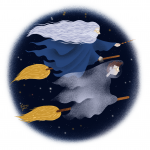
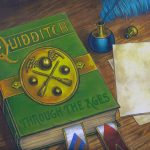
"As every school-age wizard knows, the fact that we fly on broomsticks is probably our worst-kept secret. No Muggle illustration of a witch is complete without a broom and however ludicrous these drawings are (for none of the broomsticks depicted by Muggles would stay up in the air for a moment), they remind us that we were careless for far too many centuries to be surprised that broomsticks and magic are inextricably linked in the Muggle mind."
-- Kennilworthy Whisp, Quidditch Through the Ages (QA5)
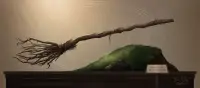
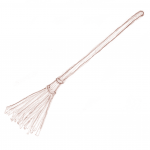
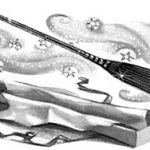
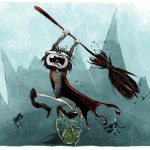
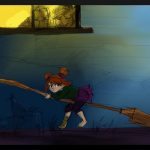
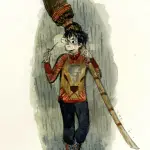
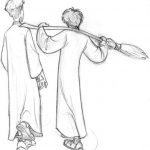
Brooms are a magical mode of transportation in the Wizarding World.
About Broomsticks
A flying broomstick is not simply a “normal” broomstick pressed into service as a mode of transportation. The flying broomstick is a magical item with built-in charms. The earliest known evidence of a broomstick enchanted to fly dates to 962 AD; brooms are thought to have been chosen because they are easily transported and concealed from Muggles (QA1). As time passed, they would also prove to be conducive to playing a number of sports.
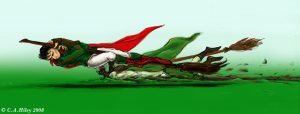
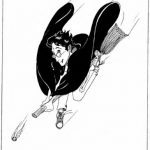
Flying on a broomstick, particularly one which accelerates as quickly as the Firebolt, must necessarily involve some form of magic protective field holding rider to broom and shielding against wind and inertial forces. Without this, it seems unlikely that anyone could hang on when a Firebolt accelerates from zero to 150 mph in only ten seconds (PA4). It also seems likely that flying a broomstick doesn’t involve actually sitting on the handle, which would be uncomfortable indeed. As a matter of fact, most illustrations we see in the books show the rider floating a little ways above the handle. The spell which creates this effect is called the Cushioning Charm, invented by Elliot Smethwyk in 1820 (QA9).

For more about the history of broomsticks, please purchase the book Quidditch Through the Ages. Information about broomsticks can be found particularly in chapters one and nine.
Brooms at Hogwarts
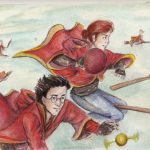
Broomsticks and broom sports hold a special place in the hearts of Hogwarts students. Quidditch matches are routinely attended by nearly every student and teacher in the school, and star fliers have near-celebrity status among the student body.

Brooms, even those owned by students, are normally stored in a broomshed by the Quidditch pitch (PS13), although when Harry gets a Firebolt he keeps it in his dormitory out of concern for its safety (PA15). This is probably smart, as the broomshed can get quite cold – Hagrid is seen outside on one cold fall morning defrosting the brooms from the shed (PS11). Hogwarts owns a number of brooms, but they are old and don’t fly especially well; Harry dreads the thought of playing a Quidditch match on one after his broom is destroyed (PA10). These brooms are used primarily for flying lessons, which first years take with Madame Hooch (PS9), though most of them can’t fly very well (HBP11).
Spells Cast on Brooms
Broomsticks are certainly charmed objects. They even seem to be at least semi-sentient. The best ones seem to respond to thoughts. When Harry was nearly thrown from his broom during his first year, Hagrid said that a simple collision couldn’t have caused it to act that way because
“….can’t nothing interfere with a broomstick except powerful Dark magic–no kid could do that to a Nimbus Two Thousand” (PS11).
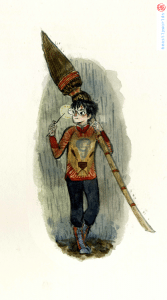
This magic doesn’t replace the skill of the flyer, of course, but rather protects and enables them to fly with amazing speed and dexterity. Even when the rider has fallen off the broom, it doesn’t fall from the sky, but rather it drifts off on its own (PS9, PA9).
For information about specific spells used on broomsticks, see Broomstick Magic.
Broom Sports
Aingingein in Ireland (QA2)
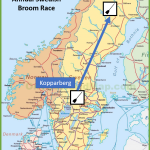
annual broom race in Sweden (QA2)
Creaothceann from Scotland (QA2, QA3)

Quidditch
Quodpot, invented in the US and played in the Americas (QA2, QWC, Pm)
Shuntbumps in England (QA2)
Stichstock from Germany (QA2)
Swivenhodge in England (QA2)
Broomstick Accessories
broomstick servicing kit
Brush, Self-Straightening
Buzzer, Anti-Burglar
varnish, anti-jinx (Cleansweep 11) (OP9)
vibration control, in-built (Cleansweep 11) (OP9)
Warning Whistle
Broom Companies & Models
Again, for more information about many of these brooms, please purchase the book Quidditch Through the Ages.
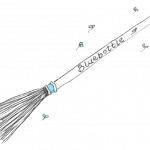
- Bluebottle
- Cleansweep series brooms
- Comet series brooms
- The Firebolt, developed by Randolph Spudmore
- Moontrimmer (Gladys Boothby)
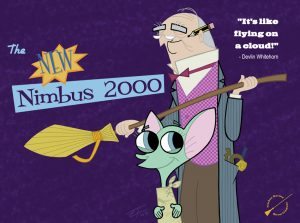
- Nimbus series brooms
- Oakshaft 79 (Elias Grimstone)
- Shooting Star, developed by Universal Brooms Limited
- Silver Arrow, developed by Leonard Jewkes
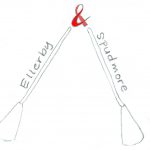
- Swiftstick (Ellerby & Spudmore)
- Tinderblast (Ellerby & Spudmore)
- Twigger 90, developed by Flyte and Barker
Several new brooms made their mark at the Quidditch World Cup tournament in 2014 (QWC):
- Firebolt Supreme (Bulgaria);
- Starsweeper XXI (USA);
- Thunderbolt VII (Nigeria);
- Varåpidos (Brazil) and
- Yajirushi (Japan).
Commentary
Etymology
The words "broom" and "broomstick" are both used to mean the same thing throughout the wizarding world.




















From the Web
Writing by J K Rowling on WizardingWorld.com (Pottermore):
Writing by J K Rowling on Imgur (Daily Prophet coverage of the 2014 Quidditch World Cup, originally from Pottermore):
- History of the Quidditch World Cup
- Quidditch World Cup 1990-2014
- Match reports and articles from the 2014 Quidditch World Cup
Harry Potter Wiki: Brooms
WizardingWorld.com (Pottermore) features:
Screenrant: Ranked: All The Broomsticks In Harry Potter By Speed
Pensieve (Comments)
Tags: fast flying gifts lessons magical concealment racing sports twigs wood